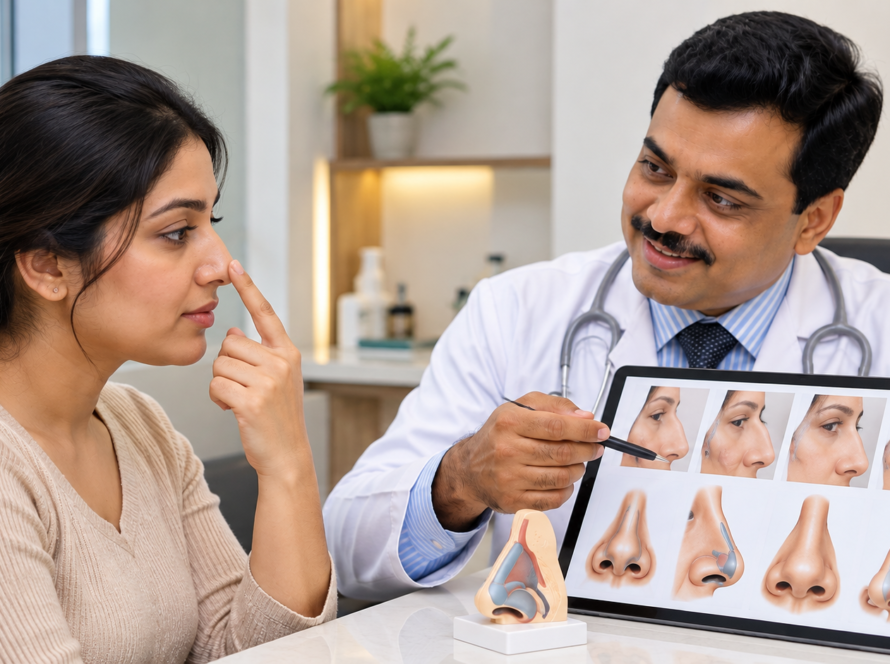
Crooked nose treatment in Surat begins with an examination that separates bony deviation, cartilaginous deviation and septal deviation. This distinction matters because each type can require a different correction. A crooked nose may also involve more than one structural area.
The aim of assessment is not simply to make the nose look straight from one angle. The surgeon also considers nasal structure, breathing, facial balance, previous injury or surgery and what degree of improvement is realistically achievable.
Even after a straightening procedure, some residual asymmetry can remain because healing and individual anatomy vary.
How is a crooked nose assessed at the first consultation?
The first consultation begins with understanding what has made the nose appear or become crooked.
The surgeon may ask about:
- Whether the nose has always looked crooked
- Previous nasal injuries or fractures
- Previous nose surgery
- Difficulty breathing through one or both nostrils
- Changes in the nose over time
- Whether the concern is mainly appearance, breathing or both
- Your expectations from treatment
The nose is then examined from different views. The external nasal bones, cartilage and tip are assessed along with the internal nasal structure.
This is important because a nose that looks crooked externally may also have a deviated septum internally. Conversely, an external asymmetry does not automatically mean that the septum is the only problem.
Current information from Elegance Clinic describes crooked nose correction as an assessment of the bone, cartilage and septum together, with treatment selected according to the underlying structure.
Which corrections suit bony, cartilaginous and septal deviation?
A crooked nose is not one single condition. The visible deviation may involve bone, cartilage, the septum or a combination.
| Deviation type | How it looks and feels | Examination finding | Usual corrective step | Expected recovery |
|---|---|---|---|---|
| Bony deviation | The upper or middle nose may lean to one side or look displaced, particularly after an old injury. | The nasal bone framework is assessed for asymmetry or displacement. | Bone reshaping or repositioning may be considered as part of rhinoplasty or post-traumatic correction. | Swelling and bruising can occur, with recovery varying according to the extent of correction. |
| Cartilaginous deviation | The bridge or tip may appear twisted, tilted or uneven. | The cartilage framework and nasal tip are examined for asymmetry and support. | Structural cartilage correction or rhinoplasty techniques may be used according to the deformity. | Cartilage healing and swelling continue after surgery, so the final appearance develops gradually. |
| Septal deviation | One side may feel more blocked, and breathing can be more difficult. | The internal septum is examined to assess deviation and its relationship with the airway. | Septoplasty may be considered when the septum is contributing to the problem. | Internal healing continues after surgery and the timing of improvement varies. |
| Combined deviation | The nose may look crooked externally while breathing is also affected. | Bone, cartilage and septum are assessed together. | A combined rhinoplasty and septal correction may be appropriate when both external shape and internal structure require correction. | Recovery depends on the number and extent of corrections performed. |
The table is a framework for understanding the assessment. It does not mean that one treatment automatically applies to every person with the same type of deviation.
When is breathing assessment part of the same plan?
Breathing should be discussed when a crooked nose is associated with nasal blockage, difficulty exercising, disturbed sleep or one-sided airflow problems.
The surgeon may examine the internal nasal structure as well as the external appearance. If a deviated septum is contributing to the breathing problem, septal correction may form part of the treatment plan.
This is why deviated nose correction Surat should not be planned from photographs alone. A physical examination helps determine whether the issue is primarily cosmetic, functional or a combination of both.
Elegance Clinic’s current crooked-nose information also notes that crookedness can be associated with breathing concerns and that septal work may be combined with rhinoplasty when appropriate.
What does the treatment pathway from consultation to surgery look like?
The treatment pathway generally starts with consultation and assessment rather than immediately deciding on surgery.
Step 1: Consultation and examination
The surgeon reviews your concern, medical history, previous injury or surgery and breathing symptoms.
The nose is examined from the front, side and other relevant views.
Step 2: Identify the structural problem
The assessment separates the contribution of bone, cartilage and septum.
Some patients have a single structural issue, while others have combined deviation.
Step 3: Discuss treatment options
Depending on the examination, options may include observation, non-surgical camouflage for selected mild cosmetic irregularities, septal surgery, rhinoplasty or a combination of procedures.
Current Elegance Clinic information states that mild external asymmetry can sometimes be camouflaged with fillers, but fillers do not straighten underlying bone or cartilage and do not correct breathing problems caused by septal deviation.
Step 4: Discuss realistic expectations
The surgeon should explain what can reasonably be improved.
The goal is generally improved alignment and balance rather than promising mathematically perfect symmetry.
Step 5: Plan surgery when appropriate
If surgery is selected, the procedure is planned around the structural findings and the patient’s goals.
Step 6: Recovery and follow-up
After surgery, swelling gradually settles. Follow-up appointments allow the surgeon to monitor healing and assess the developing result.
Can a crooked nose be made perfectly straight?
A perfectly straight nose cannot always be guaranteed.
The nose is a three-dimensional structure made of bone, cartilage and soft tissue. Natural facial asymmetry is common, and healing can affect the final appearance.
The goal of crooked nose treatment in Surat should therefore be discussed in terms of realistic improvement rather than a promise of absolute symmetry.
This is particularly important when the nose has been crooked for many years or has previously been injured or operated on.
A current Elegance Clinic guide similarly notes that recovery timelines and outcomes vary between patients and that treatment needs to be based on individual anatomy.
Is a CT scan needed before crooked nose surgery?
A CT scan is not automatically required for every patient with a crooked nose.
Whether imaging is useful depends on the symptoms, examination findings, history and the specific surgical plan. If the surgeon believes imaging is necessary, it can be arranged as part of the assessment.
Do not assume that a CT scan is required simply because the nose looks crooked externally.
The physical examination remains an important part of determining which structures need correction.
Can Botox or filler help a mildly crooked nose?
Non-surgical treatment can sometimes camouflage a mild external irregularity, but it does not physically straighten the nasal skeleton.
Fillers add volume and can sometimes alter the appearance of a small contour irregularity. They cannot remove a bony deviation, permanently reshape structural cartilage or correct a breathing problem caused by a deviated septum.
Botox is different again. It may affect certain dynamic muscular effects but cannot physically straighten bent nasal bones or cartilage.
Therefore, the appropriate choice depends on why the nose looks crooked.
Does correcting the septum straighten the outside of the nose?
Not necessarily.
The septum is the internal structure dividing the nasal passages, while the external nose is supported by bone and cartilage.
If septal deviation contributes to external crookedness, correcting the septum may be part of improving the overall alignment. However, an external bony or cartilaginous deviation may require additional correction.
This is why the treatment plan should be based on an assessment of both the internal and external nose.
What happens if an old injury caused the crooked nose?
An old injury can still be assessed years later.
A previous fracture may have healed with the nasal bones in a displaced position. Trauma can also affect cartilage and the septum.
Treatment for an old injury therefore depends on the current structure rather than simply how long ago the accident occurred.
Post-traumatic rhinoplasty can be used when structural changes from an old injury affect appearance or function. Current information from Elegance Clinic describes post-traumatic treatment as assessment and correction of injury-related nasal deformities, including crookedness and breathing concerns.
How long is recovery and when is the result reviewed?
Recovery depends on the extent of correction and the structures involved.
Swelling does not disappear immediately after a straightening procedure. The nose continues to change as tissues heal.
Follow-up appointments allow the surgeon to check healing and discuss the developing result.
There is therefore no single recovery timetable that applies to every patient. A patient undergoing a more extensive structural correction may have a different recovery experience from someone undergoing a smaller procedure.
What about crooked nose surgery cost in Surat?
Crooked nose surgery cost Surat is not a single fixed amount.
The final cost can depend on what needs to be corrected, whether the procedure involves the nasal bones, cartilage, septum or several structures, the complexity of the surgery and the associated treatment arrangements.
For this reason, a consultation is needed before an individual surgical cost can be established.
A cost discussion should also make clear what is included in the quoted treatment and whether additional medical or follow-up requirements could affect the total.
What does non-surgical correction actually achieve?
For selected mild cosmetic irregularities, a filler-based approach may camouflage an external contour issue.
However, it does not physically straighten the underlying nasal framework.
This distinction is important for anyone researching bent nose treatment Surat. A treatment that makes a nose appear straighter from a particular view is different from correcting the structural cause of deviation.
If breathing is affected, a non-surgical cosmetic camouflage does not replace assessment and treatment of the internal airway problem.
Choosing a nose straightening surgeon in Surat
When searching for a nose straightening surgeon Surat, focus on whether the consultation addresses both the appearance and structure of your nose.
Useful questions include:
- What is causing my nose to look crooked?
- Is the deviation mainly bone, cartilage, septum or a combination?
- Is my breathing affected?
- Would septal correction be part of the treatment?
- What degree of straightening is realistic?
- What happens if some asymmetry remains after healing?
- Is imaging necessary in my case?
- What recovery should I expect?
- How many follow-up visits are planned?
- What is included in the estimated treatment cost?
The surgeon should be able to explain why a particular correction is being recommended rather than simply offering a generic rhinoplasty plan.
How many follow-up visits are needed in Surat?
There is no universal number of visits for every crooked-nose patient.
Follow-up depends on the procedure, healing and the surgeon’s protocol. Early appointments can assess initial healing, while later reviews can evaluate how swelling and structural changes are settling.
Ask for the expected follow-up schedule before surgery so you know what to plan around work, travel and other commitments.
What degree of straightening is realistic?
Realistic improvement is different from perfect symmetry.
A successful treatment plan aims to improve the structural deviation and create better facial balance while preserving or improving nasal function where appropriate.
The final appearance can still show some natural asymmetry because facial structures are not perfectly symmetrical and healing varies.
This is one reason realistic expectations should be discussed before surgery rather than judged immediately after it.
Crooked nose treatment pathway in Surat
The pathway can be summarized as:
Consultation → External and internal examination → Identify bone, cartilage and septal deviation → Assess breathing → Discuss surgical or selected non-surgical options → Plan treatment → Surgery when appropriate → Recovery → Follow-up → Final assessment
The specific pathway can change depending on whether the deviation is bony, cartilaginous, septal or combined.
Helpful crooked nose resources
For further reading, you can review:
- Can a crooked nose be fixed
- How a deviated nose is corrected
- Crooked nose treatment service page
- Bent and crooked nose correction
The clinic’s current published information describes crooked nose correction as individualized according to the cause and anatomy, with rhinoplasty, septal correction or combined approaches considered where appropriate.
FAQs
Not always. The realistic goal is improvement in alignment and facial balance, while some residual asymmetry may remain.
Not necessarily. Imaging depends on the symptoms, examination findings and surgical plan.
Filler can sometimes camouflage a mild external irregularity, but it does not straighten the underlying bone or cartilage. Botox cannot physically straighten structural nasal deviation.
Not always. Septal correction may help when the septum contributes to external deviation, but additional correction may be needed for the nasal bones or cartilage.
The number varies according to the procedure and healing. Your surgeon can provide an expected follow-up schedule.
Yes, an old nasal injury can still be assessed. Treatment depends on the structural changes that remain and whether they affect appearance, breathing or both.