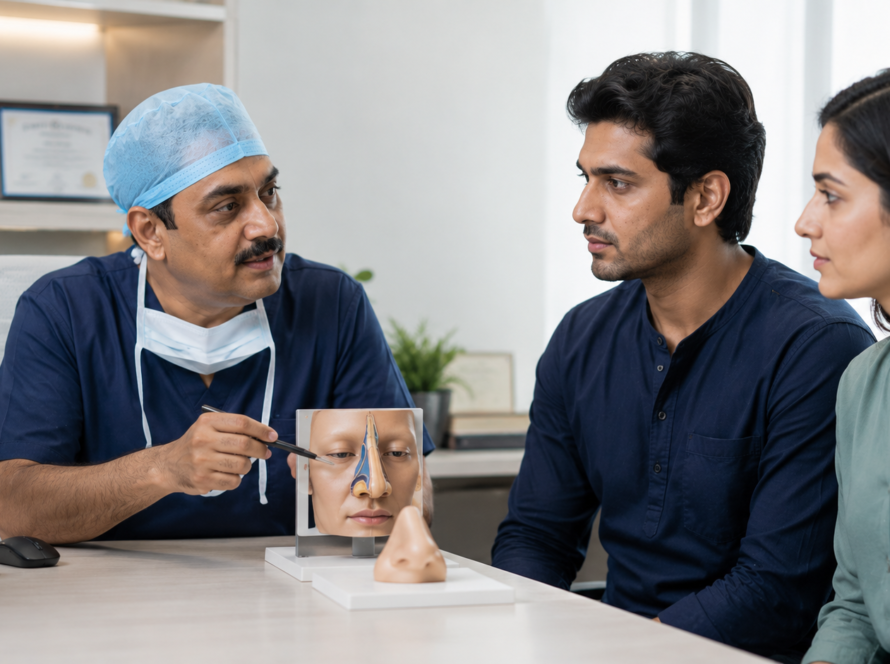
Rhinoplasty can change the shape, structure and sometimes the function of the nose, but it is still surgery and no result can be guaranteed. A proper consent discussion should cover not only the expected swelling and bruising but also bleeding, infection, altered breathing, numbness, asymmetry, visible irregularities and the possibility of another operation.
Some problems are mainly part of the early recovery period and improve as swelling settles. Others may become apparent only after several months, when the nose has healed and the final shape becomes clearer.
The important question before surgery is therefore not simply “Is rhinoplasty safe?” It is:
“What are the realistic risks for this particular operation, how would they be managed, and what happens if the result is not as expected?”
Published rhinoplasty data show that revision surgery does occur in a proportion of patients. In a large European collaborative dataset covering 41,259 rhinoplasties, 1,730 primary rhinoplasties underwent revision surgery, equivalent to about 5% in that dataset. The most commonly reported reasons for revision included dorsal asymmetry, nasal blockage and dissatisfaction with the nasal tip.
That percentage should not be treated as a universal personal risk. Revision rates vary according to the type of rhinoplasty, the reason for surgery, surgical technique, patient characteristics and length of follow-up.
What Risks Should Be Discussed Before Rhinoplasty?
A consent discussion should cover both common temporary effects and less common complications that could require treatment or another operation.
Potential risks include:
- Bleeding or nosebleeds
- Infection
- Swelling and bruising
- Pain or discomfort
- Temporary or persistent numbness
- Altered nasal sensation
- Breathing difficulty or a change in airflow
- Nasal blockage
- Visible irregularity
- Asymmetry
- Changes in the nasal tip
- Scarring, particularly with an open approach
- Delayed healing
- Persistent swelling
- Unsatisfactory aesthetic result
- Structural problems
- Need for revision surgery
The precise risks depend on what is being changed. A rhinoplasty performed primarily for a dorsal hump is not the same operation as a complex septorhinoplasty involving the nasal septum, valves or grafts.
Which Complications Can Occur During the First Two Weeks?
The first two weeks are dominated by the normal inflammatory response to surgery.
Swelling, bruising, congestion, mild discomfort and altered sensation can occur during this period. A 2025 systematic review of rhinoplasty postoperative management describes pain, swelling and bruising as important aspects of early recovery.
Bleeding
Some blood-stained nasal discharge can occur after surgery. More significant bleeding is different and may require assessment.
Patients should follow the surgeon’s instructions about activity, medication, nasal care and what to do if bleeding occurs.
Swelling and bruising
Swelling around the nose and under the eyes is common after rhinoplasty. It can make the nose appear temporarily larger or less symmetrical than the eventual result.
This is one reason it is too early to judge the final appearance during the first days or weeks.
Congestion and breathing changes
Nasal blockage is common during early recovery because of swelling, internal healing and postoperative care. A temporary change in breathing does not necessarily mean that the final airway result will be poor.
However, significant or worsening breathing difficulty should be reported to the surgical team.
Infection
Infection is uncommon but possible after surgery.
Warning signs can include increasing redness, worsening pain, fever, pus or other symptoms that are getting worse rather than gradually improving.
An infection may require examination, medication or additional treatment.
Numbness
The nose and particularly the nasal tip can feel numb, tight or unusually sensitive after surgery.
This may improve gradually as tissues and small sensory nerves recover.
Persistent numbness should be discussed during follow-up rather than assumed to be permanent.
Which Problems May Appear Months After Surgery?
Some concerns cannot be judged properly until swelling has substantially settled.
Later problems can include:
- Persistent asymmetry
- A visible contour irregularity
- Tip asymmetry
- Residual or recurrent nasal deviation
- Persistent nasal obstruction
- Structural weakness
- Unwanted changes in nasal shape
- Persistent numbness or altered sensation
- Dissatisfaction with the aesthetic result
- Need for revision surgery
The nose continues changing during healing, and final assessment may take many months.
For revision rhinoplasty, the clinic’s current information notes that another operation is generally considered only after sufficient healing, often at least 12 months after the original surgery.
That waiting period is important because operating again too early can mean treating a nose that has not yet reached its stable result.
Can Rhinoplasty Permanently Change Breathing?
Yes, rhinoplasty can affect nasal breathing, which is why functional assessment should be part of the consultation when breathing is already a concern.
A well-planned operation may improve breathing when structural problems are addressed, but surgery can also create or leave persistent obstruction in some patients.
Potential functional problems include:
- Persistent nasal blockage
- Narrowing of an important airway area
- Nasal valve problems
- Residual septal deviation
- Structural weakness
- Changes in airflow sensation
The risk depends heavily on the anatomy and the operation being performed.
If you already have difficulty breathing through your nose, tell the surgeon before surgery. Cosmetic goals and functional goals should be discussed together rather than treating them as completely separate issues.
How Common Is Revision Surgery?
There is no single revision rate that applies to every rhinoplasty.
Revision means another operation is performed because the original procedure has left a persistent aesthetic or functional concern or because a new structural problem requires correction.
In the large European surgeon dataset, about 5% of primary rhinoplasty procedures were followed by revision surgery. The reasons most commonly reported included dorsal asymmetry, nasal blockage and dissatisfaction with the nasal tip.
Other studies show different revision rates because they examine different surgical techniques and patient groups. For example, a meta-analysis of diced-cartilage dorsal augmentation reported a pooled revision rate of 5.3% in the studies included, illustrating why a figure from one technique should not be presented as the universal rhinoplasty revision rate.
Why might someone need revision?
Possible reasons include:
- Persistent asymmetry
- Residual nasal deviation
- Nasal obstruction
- Tip irregularity
- Contour irregularity
- Structural weakness
- Graft-related problems
- Changes that become apparent after swelling resolves
- An aesthetic result that does not meet the agreed goals
Revision surgery is usually more complex because the tissues have already been operated on and scar tissue may be present.
What Patient Factors Can Increase Risk?
Risk is not determined by the nose alone.
The surgeon should consider:
- Existing breathing problems
- Septal deviation
- Nasal valve problems
- Previous nasal surgery
- Previous trauma
- Smoking or tobacco use
- Medical conditions affecting healing
- Medicines that affect bleeding
- Previous problems with anaesthesia
- Skin and soft-tissue characteristics
- Unrealistic expectations
- The complexity of the planned operation
Previous surgery is particularly important because revision rhinoplasty involves altered anatomy and scar tissue.
The clinic’s current revision-rhinoplasty information explains that previously operated tissues, scar formation, altered cartilage and reduced structural support can make secondary surgery more complex.
Do Smoking and Tobacco Increase Rhinoplasty Risk?
Smoking and tobacco exposure should be discussed before rhinoplasty.
Smoking can impair wound healing and is associated with postoperative complications across surgical fields. Tobacco exposure can affect blood vessels and oxygen delivery, which are important during tissue healing.
For rhinoplasty, this matters because the skin, soft tissue, cartilage and surgical wounds all need to heal properly.
If you smoke or use tobacco:
- Tell the surgeon honestly.
- Ask how long before surgery you should stop.
- Follow the surgeon’s cessation instructions.
- Do not assume that switching from cigarettes to another tobacco product removes the concern.
The exact cessation period should be individualised by the surgical team.
How Are Rhinoplasty Complications Managed?
Management depends on the complication and how severe it is.
Bleeding
Minor bleeding may be managed with observation and the surgeon’s prescribed instructions. Significant or persistent bleeding may require urgent assessment and additional treatment.
Infection
A suspected infection may require examination and appropriate medication. More serious infections can require additional intervention.
Breathing problems
The first step is identifying the cause.
Early blockage may be related to swelling and healing. Persistent obstruction may require examination of the septum, nasal valves, internal structures or scar tissue.
Treatment can range from observation to medical treatment or, in selected cases, revision surgery.
Asymmetry or irregularity
Early asymmetry may simply reflect uneven swelling.
If asymmetry remains after adequate healing, the surgeon may discuss observation, non-surgical options where appropriate, or revision surgery.
Numbness
Most postoperative sensory changes are monitored while healing progresses.
Persistent or troublesome altered sensation should be assessed during follow-up.
Revision surgery
Revision is considered only when there is a defined problem and the nose has had sufficient time to heal.
A revision should have a specific objective rather than being performed simply because the nose looks different during the early recovery period. The clinic’s current revision information similarly describes revision as a procedure for persistent functional or aesthetic problems after healing.
Rhinoplasty Risk Table
| Complication | When it typically appears | How it may present | How it may be managed | What reduces the risk |
|---|---|---|---|---|
| Bleeding | Early postoperative period | Persistent or heavier bleeding/nosebleed | Assessment, pressure/instructions, and further treatment if required | Careful surgical technique and following postoperative instructions |
| Infection | Usually early, but can occur later | Increasing pain, redness, swelling, fever or discharge | Clinical assessment and appropriate treatment | Sterile technique, wound care and following aftercare instructions |
| Swelling/bruising | First days to weeks | Puffy nose, facial bruising, temporary asymmetry | Time, prescribed aftercare and observation | Following recovery instructions |
| Breathing change | Early or later | Congestion, blockage or altered airflow | Observation, medical treatment or further structural assessment | Preoperative functional assessment and appropriate surgical planning |
| Numbness | Early; may persist longer | Reduced sensation, especially around the tip | Observation and follow-up | Careful surgical planning and allowing nerves to recover |
| Asymmetry | Early or after swelling settles | Uneven sides, tip or bridge | Observation initially; revision may be considered after healing | Realistic planning and appropriate technique |
| Visible irregularity | Often becomes clearer as swelling settles | Contour irregularity or palpable/visible unevenness | Observation, assessment and possible correction | Careful structural planning and follow-up |
| Persistent obstruction | May become apparent after recovery | Ongoing difficulty breathing through the nose | Identify structural cause; treatment may include revision | Functional assessment before surgery |
| Revision requirement | Usually assessed after adequate healing | Persistent aesthetic or functional problem | Secondary/revision rhinoplasty in selected cases | Appropriate patient selection, planning and realistic expectations |
What Should a Consent Discussion Cover?
Consent should be a conversation, not simply a signature on a form.
Before agreeing to a surgery date, the discussion should cover:
1. Why are you having rhinoplasty?
Is the main goal:
- Cosmetic change?
- Breathing improvement?
- Correction after trauma?
- Correction of a previous surgery?
- A combination of functional and aesthetic goals?
2. What exactly will be changed?
Ask what will happen to:
- The bridge
- The nasal tip
- The septum
- The nasal bones
- The nostrils
- The nasal valves
- Cartilage
- Any grafts that may be required
3. What are the realistic limitations?
The surgeon should explain what surgery can and cannot predictably achieve.
A computer simulation or reference photograph should not be treated as a guarantee of the final result.
4. What are the early risks?
The consent discussion should cover:
- Bleeding
- Infection
- Swelling
- Bruising
- Pain
- Congestion
- Numbness
- Medication or anaesthesia-related risks
5. What are the longer-term risks?
Discuss:
- Persistent asymmetry
- Irregularities
- Breathing changes
- Structural problems
- Persistent numbness
- Unsatisfactory appearance
- Revision surgery
6. What happens if something goes wrong?
Ask:
- Who should you contact?
- What symptoms require urgent assessment?
- How will bleeding be managed?
- What happens if infection develops?
- What happens if breathing remains difficult?
- When would revision be considered?
7. What is the possibility of revision?
The surgeon should explain that revision surgery is possible and that its likelihood varies by patient and procedure.
A specific personal percentage should not be promised unless it is based on an appropriate evidence source and the individual’s circumstances.
What Should You Ask Before Agreeing to a Surgery Date?
A useful consent discussion checklist is:
Procedure
- What exactly is being changed?
- Is this cosmetic, functional or both?
- Will the septum or nasal valves be addressed?
Risks
- What are my specific risks?
- What are the early complications?
- What problems may only become apparent months later?
- Could my breathing become worse?
Recovery
- How long will swelling and bruising last?
- When can I return to work?
- When can I exercise?
- When will the nose be stable enough to judge?
Revision
- What could lead to revision?
- How long would we wait before considering another operation?
- What would revision involve?
Personal factors
- Does smoking affect my risk?
- Do my medications affect bleeding?
- Does any previous nasal surgery or trauma change the plan?
Emergency care
- Who do I contact outside clinic hours?
- Which symptoms require urgent assessment?
You should understand the answers before agreeing to the operation.
What Should I Do If Something Looks Wrong at Home?
Do not panic based on appearance alone during the first days after surgery.
Swelling can make the nose look uneven, larger or different from the expected shape. Early asymmetry does not automatically mean that the final result will be asymmetric.
However, contact your surgical team if you develop:
- Significant or persistent bleeding
- Increasing rather than improving pain
- Fever
- Increasing redness or swelling
- Pus or concerning discharge
- Sudden or severe breathing difficulty
- A rapidly worsening change in the nose
- Any symptom that your postoperative instructions identify as urgent
If you have severe symptoms or an emergency, seek urgent medical attention rather than waiting for a routine follow-up.
Frequently Asked Questions
Serious complications are uncommon, but the exact risk varies according to the procedure, patient factors and definition used. Rhinoplasty still carries risks such as bleeding, infection, breathing problems, structural irregularity and the possibility of revision.
Yes. Rhinoplasty can affect nasal airflow. It may improve breathing when functional problems are correctly addressed, but persistent or new obstruction can also occur. Functional assessment should therefore be part of the consultation when breathing is a concern.
Usually, postoperative numbness or altered sensation is monitored during healing, and sensation may gradually return. Persistent numbness can occur and should be discussed with the surgeon if it does not improve.
Factors include the complexity of the operation, previous surgery, structural problems, healing, asymmetry, persistent breathing difficulty and the patient’s individual anatomy. Revision rates also differ substantially between studies and procedures.
Smoking and tobacco exposure can impair healing and should be disclosed before surgery. Your surgeon should give you specific instructions about when to stop before and after rhinoplasty.
Contact your surgical team if the problem is worsening or you have significant bleeding, fever, increasing pain, infection symptoms or serious breathing difficulty. Do not judge the final cosmetic result during the early swelling period.
Consent Should Cover More Than the Expected Result
Rhinoplasty consent should not focus only on the nose you hope to achieve. It should also explain what can go wrong, how those problems may appear, what can be treated conservatively, and when another procedure might be necessary.
The main risks include bleeding, infection, swelling, altered breathing, numbness, asymmetry and visible irregularity. A proportion of patients undergo revision surgery, but the percentage varies between populations and procedures rather than being one fixed number.
Before choosing a surgery date, make sure you understand the proposed operation, your individual risk factors, the expected recovery, warning signs, follow-up plan and the possibility of revision.
A good consent discussion gives you enough information to make an informed decision about whether the procedure and its potential risks are acceptable to you.