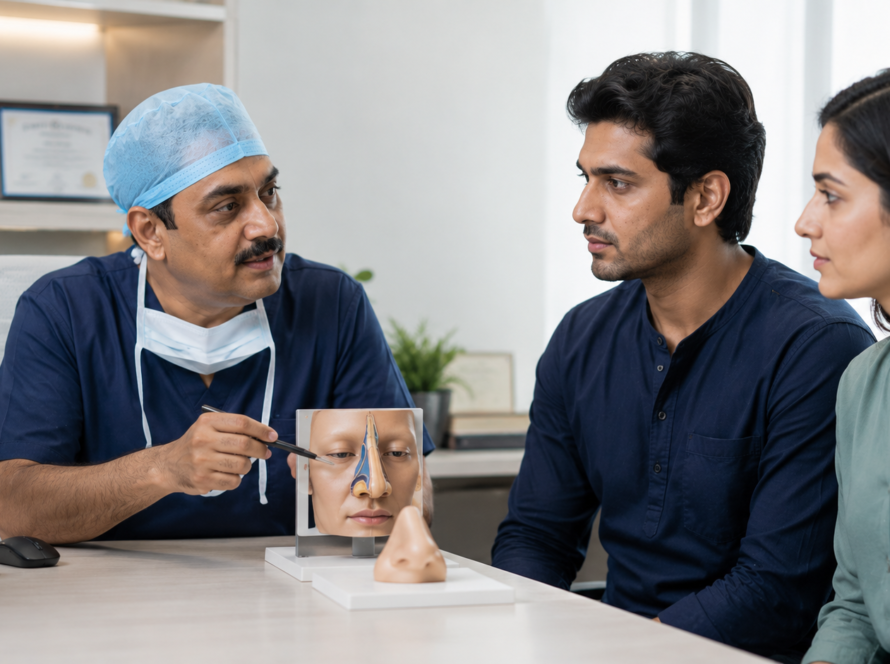
Written by Dr. Ashutosh Shah, M.Ch., DNB (Plastic Surgery)
Founder & Director, Elegance Clinic, Surat
Dr. Ashutosh Shah is a Board-Certified Plastic, Cosmetic, Reconstructive and Hair Transplant Surgeon with more than 22 years of surgical experience. He completed his M.Ch. in Plastic Surgery from The M.S. University of Baroda and holds a DNB in Plastic Surgery. He has advanced training in microvascular and cosmetic surgery and has performed thousands of cosmetic and reconstructive procedures.
Yes, the side profile of the nose can often be changed with rhinoplasty, but a “nose side fix” is not one standard procedure. The right approach depends on what makes the profile look unbalanced. The concern may involve a prominent hump, a drooping or over-projected tip, a low bridge, an irregular nasal contour, or the relationship between the nose and other facial features.
Rhinoplasty can modify both bone and cartilage to change nasal shape and proportion. The American Society of Plastic Surgeons (ASPS) notes that rhinoplasty can address nose size, bridge width, visible humps or depressions, tip shape, nostril characteristics and asymmetry.
However, side-profile correction should not be planned by looking at the bridge alone. The forehead, lips and chin influence how prominent the nose appears. In some patients, a nose that seems “too large” from the side is partly a facial-proportion issue rather than simply excess nasal tissue.
A good rhinoplasty plan therefore asks: Which part of the profile needs changing, how much change will remain proportional to the face, and can that change be achieved without compromising nasal function?
The goal is improvement in balance—not creation of one standard nose or a guaranteed “perfect” profile.
Key Takeaways
- Rhinoplasty can change several features visible from the side profile.
- A dorsal hump, drooping tip, excessive projection or low bridge requires a different surgical plan.
- Removing a hump alone does not necessarily create a balanced profile.
- Facial proportions, particularly the chin and lips, should be considered during planning.
- Swelling can hide the final nasal contour for months after surgery.
- Rhinoplasty has potential risks and cannot guarantee perfect symmetry or a specific appearance.
- A physical examination is necessary to determine whether the desired change is realistic.
Why Can the Nose Look Unbalanced From the Side?
A nose may appear unbalanced from the side because of its bridge height, hump, tip position, projection, rotation or overall relationship with the forehead, lips and chin. Identifying the actual cause is essential because different profile concerns require different corrections.
Dorsal Hump: A visible prominence along the bridge of the nose that can affect the smoothness of the side profile.
Common concerns include a bump along the bridge, a tip that points downward, excessive nasal projection, a relatively flat bridge or an irregular contour following previous surgery or injury.
Importantly, the nose does not exist visually in isolation. Facial proportions can change how large or small it appears.
Can Rhinoplasty Fix the Side Profile of the Nose?
Rhinoplasty can modify the nasal bridge, tip, projection and other structural features to improve the side profile. The exact changes depend on the patient’s anatomy, breathing function, skin and cartilage characteristics, and desired outcome.
A side-profile rhinoplasty may involve one or several adjustments.
Dorsal Hump Correction
A prominent bridge can sometimes be reduced or reshaped to produce a smoother profile. The amount of reduction should be planned carefully rather than automatically creating a completely straight or deeply curved bridge.
Tip Correction
A drooping, bulky or excessively projected nasal tip may require cartilage reshaping or structural support.
Bridge Augmentation
Some patients are concerned about a low or under-projected bridge rather than a hump. Selected cases may require structural augmentation instead of tissue reduction.
Projection and Rotation
The distance the tip projects forward and its upward or downward orientation can influence the entire side profile.
ASPS describes rhinoplasty as capable of changing several of these structural characteristics.
How Is the Right Nose Side Fix Chosen?
The appropriate correction is chosen by analysing the entire nose and its relationship with the face. A surgeon evaluates the bridge, tip, cartilage support, skin thickness, nasal airway and facial proportions before deciding which structures should—or should not—be changed.
A useful way to understand this is that the most noticeable feature is not always the only feature requiring assessment.
For example, reducing a dorsal hump without considering tip projection could leave the profile looking disproportionate. Similarly, excessive reduction can create an operated appearance or compromise structural support.
| Side-Profile Concern | Possible Approach | Key Consideration |
|---|---|---|
| Dorsal hump | Bridge reshaping/reduction | Avoid excessive reduction |
| Drooping tip | Tip support or repositioning | Maintain proportion and function |
| Over-projected tip | Projection adjustment | Must suit overall facial balance |
| Low bridge | Selected augmentation | Requires suitable material/technique |
| Irregular contour | Individualised reshaping | Cause must first be identified |
| Previous rhinoplasty problem | Revision assessment | Scar tissue can increase complexity |
What Happens During Side-Profile Rhinoplasty?
Rhinoplasty can be performed using an open or closed approach, depending on the changes required. The surgeon may reshape bone, modify cartilage, reposition structural elements or add support where necessary.
Open Rhinoplasty: An approach involving internal nasal incisions plus a small incision across the tissue between the nostrils, allowing wider exposure of nasal structures.
Closed Rhinoplasty: An approach in which surgical incisions are made inside the nostrils.
Neither approach is universally better. The choice depends on anatomy and surgical goals.
A side-profile correction should also consider breathing. Cosmetic changes should not be planned without evaluating nasal function.
What Is Recovery Like After Rhinoplasty?
Early rhinoplasty recovery commonly involves swelling, bruising, congestion and tenderness. Many visible early effects improve progressively, but internal healing and refinement of the nasal contour continue for considerably longer.
A splint may be used during the early recovery period. Patients generally receive individual instructions about sleeping position, exercise, glasses, nasal care and returning to routine activities.
ASPS notes that swelling gradually decreases and that nasal contour can continue refining for up to a year, although much of the swelling resolves earlier.
Recovery varies with the extent of surgery and individual healing.
When Will the Final Side Profile Be Visible?
The profile begins changing immediately after surgery, but the early appearance is not the final result.
Swelling can temporarily make the bridge or tip appear wider, higher or less defined than expected. The nasal tip may take particularly long to settle.
This is why patients should avoid judging a rhinoplasty result during the early healing phase.
Results can be long-lasting because rhinoplasty structurally changes the nose, but the face and nose continue to change naturally with ageing.
What Are the Risks of Nose Side-Profile Correction?
Rhinoplasty is surgery and carries potential complications. Risks can include bleeding, infection, altered sensation, scarring, breathing difficulties, asymmetry, persistent swelling and dissatisfaction with the cosmetic result. Additional surgery may occasionally be considered.
ASPS lists risks including infection, poor wound healing, changes in skin sensation, breathing difficulty, nasal asymmetry and the possibility of revision surgery.
Individual risk depends on anatomy, medical history, previous nasal surgery, procedure complexity and healing.
Who May Be Suitable for Side-Profile Rhinoplasty?
Adults concerned about a structural feature of their nasal profile may consider an assessment when expectations are realistic and general health is appropriate for elective surgery.
Rhinoplasty may be considered for concerns involving the bridge, tip or overall nasal proportion, but surgery is not automatically necessary simply because someone dislikes a photograph or a particular viewing angle.
The decision should follow a detailed examination and discussion of achievable changes, limitations and risks.
When Should You See a Rhinoplasty Specialist?
A consultation may be useful when a nasal feature consistently concerns you from the side, when nasal shape changed after injury, when a previous rhinoplasty created an unwanted profile, or when appearance concerns occur alongside breathing difficulty.
New nasal obstruction, persistent pain or changes following trauma should receive appropriate medical evaluation rather than being treated solely as cosmetic concerns.
Conclusion
A nose side fix with rhinoplasty can improve many profile concerns, including a prominent hump, drooping tip, excessive projection, low bridge or irregular contour. However, the appropriate treatment depends on which nasal structure is actually responsible for the imbalance.
Good side-profile rhinoplasty is not simply about making the nose smaller. The bridge, tip, nasal support, airway and relationship between the nose and surrounding facial features all need consideration.
Results also take time to settle, and no operation can guarantee perfect symmetry or a particular appearance. The most appropriate plan is therefore based on individual anatomy, functional needs and realistic goals.
A consultation with an appropriately qualified plastic surgeon can help determine whether rhinoplasty is suitable and what degree of profile change may realistically be achieved.
About Dr. Ashutosh Shah and Elegance Clinic
Dr. Ashutosh Shah, M.Ch., DNB (Plastic Surgery) is a Board-Certified Plastic, Cosmetic and Reconstructive Surgeon and Founder and Director of Elegance Clinic, Surat, with more than 22 years of surgical experience.
Elegance Clinic was established in 2014 and provides cosmetic and plastic surgery, dermatology, hair restoration, laser and reconstructive services through its centres in Adajan and Vesu, Surat.
Concerned about the shape or side profile of your nose?
Book a personalised consultation with Dr. Ashutosh Shah at Elegance Clinic, Surat, to understand which features are contributing to your concern and whether rhinoplasty is an appropriate option.
Frequently Asked Questions
Yes, selected structural changes can reduce apparent projection or prominence when appropriate.
A dorsal hump can often be reshaped during rhinoplasty, depending on nasal anatomy.
Tip position and support can be modified in suitable patients.
It can. Changes made for the side profile may also affect how the nose appears from the front.
Rhinoplasty creates structural changes that can be long-lasting, although natural ageing continues.
The shape becomes clearer as swelling decreases, but refinement can continue for many months.
Functional nasal problems can sometimes be addressed during nasal surgery, but they require specific assessment.