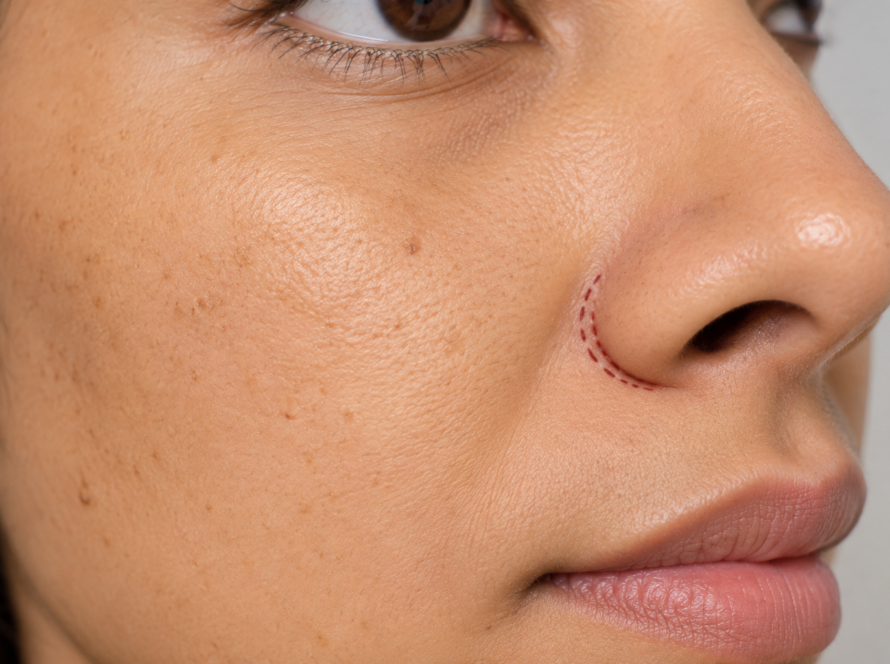
A nostril piercing usually takes 4 to 6 months to heal fully, and a septum piercing about 2 to 3 months, though both can look settled much earlier. A heavy nath should wait for full healing, so a piercing done a month before Karwa Chauth or a wedding is usually too recent.
How long does a nostril or septum piercing take to heal?
Nose piercing healing time depends on where the piercing is placed.
A nostril piercing usually takes 4 to 6 months to heal fully, while a septum piercing generally takes about 2 to 3 months. The skin can look comfortable and settled well before the deeper healing process is complete.
This difference matters if you are planning a nose piercing specifically for Karwa Chauth or a wedding. Looking healed on the outside does not necessarily mean the piercing is ready for repeated jewellery changes or the weight of traditional jewellery.
A new piercing should therefore be planned around its healing period rather than around the date of the function.
Nose piercing healing timeline
| Piercing site | Looks settled | Fully healed | First jewellery change | Safe for heavy nath |
|---|---|---|---|---|
| Nostril | May look settled before complete healing | 4-6 months | After appropriate healing and professional advice | After full healing |
| Septum | May look settled before complete healing | 2-3 months | After appropriate healing and professional advice | After full healing |
The table follows the site-specific healing times supplied for this article.
If you are considering nose piercing at the clinic, discuss the planned jewellery and the date of your wedding or Karwa Chauth before getting pierced.
The main mistake is assuming that a piercing is ready simply because there is no obvious pain.
When is it safe to switch to a nath or hoop?
A traditional nath is usually larger and heavier than the small starter jewellery used for a new piercing.
That makes timing especially important.
The supplied guidance is to wait until the piercing is fully healed before wearing a heavy nath. For a nostril piercing, that means planning around the approximately 4-to-6-month healing period, rather than assuming that a few weeks is enough.
A hoop also should not be introduced simply because the piercing looks comfortable. Changing jewellery too early can irritate the healing channel.
For a wedding or Karwa Chauth, a clip-on nath can therefore be a practical alternative when the piercing itself is too new for heavy jewellery.
If the jewellery catches, feels tight or repeatedly pulls on the piercing, do not force it into position.
Which metals and stud types are safest for a new piercing?
The supplied brief specifically requires a metals section and identifies implant-grade titanium or 14k-plus gold as the jewellery rule for new piercings.
For a fresh piercing, jewellery material matters because irritation can make the healing process more difficult.
A simple stud is generally more practical during early healing than immediately switching to large decorative jewellery.
When choosing jewellery, consider:
- Implant-grade titanium.
- 14k-plus gold.
- A suitable starter stud.
- Jewellery that does not create unnecessary pressure.
- A size and style appropriate for a healing piercing.
Avoid treating decorative bridal jewellery as starter jewellery simply because it looks attractive.
The important question is whether the piercing has healed sufficiently to tolerate the jewellery.
If you have previously developed problems around jewellery or scars, discuss the choice with a qualified professional before changing the piercing.
Can you get a nose piercing one month before a wedding?
A nostril piercing performed one month before a wedding is usually too recent if your goal is to wear a heavy nath.
The supplied healing timeline gives approximately 4 to 6 months for a nostril piercing to heal fully.
This creates a significant difference between “the piercing looks fine” and “the piercing is ready for heavy jewellery.”
If your wedding is only a month away, getting a new nostril piercing specifically for a heavy nath is therefore not consistent with the supplied healing timeline.
A temporary or clip-on nath may be considered instead, without placing the weight of the jewellery on a new piercing.
The same planning principle applies to Karwa Chauth.
Count backwards from the event date and allow enough time for complete healing rather than planning only for the piercing appointment.
Is nose piercing near athwa suitable before Karwa Chauth or a wedding?
If you are considering a new piercing before a major function, the most important issue is not simply where you have it done. It is whether enough healing time remains before you want to wear the intended jewellery.
For a nostril piercing, the supplied timeline is 4 to 6 months for full healing.
Therefore, if Karwa Chauth or a wedding is approaching within only a few weeks, a new piercing may not be suitable for wearing a heavy nath at that event.
Discuss the planned date, jewellery style and healing expectations before proceeding.
Is that lump a piercing bump, an infection or a keloid?
A lump near a nose piercing does not automatically mean that you have a keloid.
The supplied brief requires a comparison between a piercing bump, infection and keloid, because these problems can look different and require different management.
| Problem | Typical concern | What to watch for | What to do |
|---|---|---|---|
| Piercing bump | Local irritation around the piercing | Small raised area associated with irritation | Avoid unnecessary jewellery manipulation and seek advice if persistent |
| Infection | Infection involving the piercing | Increasing redness, swelling, warmth, pain or discharge | Medical assessment may be needed |
| Keloid | Excess scar tissue extending beyond the original injury | Firm raised scar that continues enlarging beyond the piercing area | Assessment by a doctor |
A persistent or enlarging lump should not be diagnosed from appearance alone.
A piercing bump caused by irritation is not the same thing as a keloid, and an infection requires different attention.
If the area is becoming increasingly painful, hot, swollen or producing concerning discharge, it should be assessed rather than repeatedly touched or squeezed.
Why does my nose piercing have a bump?
A bump can develop for several reasons, and the sheet specifically distinguishes a piercing bump from infection and keloid formation.
Repeated irritation can occur when jewellery moves excessively, catches on clothing or is changed too early.
The first step is therefore to avoid unnecessary manipulation.
Do not repeatedly squeeze, pick or rotate the jewellery to test the bump.
A bump that continues to grow, becomes increasingly painful or is accompanied by signs suggesting infection should be professionally assessed.
It is also important not to assume that every raised area is a keloid.
A doctor can assess the appearance, location and behaviour of the lesion and determine whether it is more consistent with irritation, infection or abnormal scar tissue.
When should a piercing problem be seen by a doctor?
A piercing problem should be medically assessed when it is persistent, worsening or difficult to distinguish from an infection or keloid.
Particular concerns include increasing redness, swelling, warmth, pain, significant discharge, jewellery becoming stuck or a lump that continues to enlarge.
Do not attempt to force jewellery through swollen tissue.
Likewise, do not cut, squeeze or repeatedly manipulate a persistent lump.
If the jewellery becomes embedded or stuck inside the tissue, professional assessment is particularly important.
The goal is to identify the problem early and determine whether the piercing can continue healing normally or needs specific treatment.
Can I get my nose pierced one month before my wedding?
A new nostril piercing one month before a wedding is generally too recent if you plan to wear a heavy nath.
The supplied timeline is 4 to 6 months for full nostril healing, so one month does not provide the recommended healing period.
The piercing may look settled from the outside, but that does not mean it is fully healed.
If wearing a nath is important for the wedding, a clip-on option may be more practical than placing heavy jewellery on a new piercing.
Plan the piercing several months before the event when possible.
Can I wear a clip-on nath instead?
Yes, a clip-on nath can be considered when a new piercing has not completed healing.
This can be particularly useful when a wedding or Karwa Chauth is approaching within a few weeks and there is not enough time for a nostril piercing to complete its approximately 4-to-6-month healing period.
The advantage is that the decorative nath does not need to depend on a newly healing piercing.
However, a clip-on design should still be comfortable and should not cause excessive pressure or irritation around the nose.
If it becomes painful or leaves a pressure mark, remove it rather than wearing it for an extended period.
Is gold safe for a fresh nose piercing?
The supplied jewellery guidance identifies 14k-plus gold and implant-grade titanium as suitable choices for new piercings.
However, “gold” by itself is not enough information to judge jewellery suitability.
The quality and composition of the jewellery matter.
For a new piercing, use jewellery appropriate for a healing piercing rather than immediately choosing heavy decorative bridal jewellery.
A simple, suitable stud can make more sense during healing, with a heavier nath considered only after the piercing is fully healed.
If you have a history of jewellery-related irritation or a persistent reaction, ask a qualified professional to assess the problem before changing jewellery.
Can a keloid on the nose be removed?
A suspected keloid should be assessed by a doctor before treatment is planned.
The important distinction is that a keloid is not the same as a temporary piercing bump or an infection.
The supplied brief requires doctor-attributed triage because treatment depends on what the lump actually represents.
If a raised scar continues to enlarge beyond the original piercing area, medical assessment is appropriate.
Do not attempt to cut, squeeze or remove a suspected keloid yourself.
A doctor can determine whether the lesion is consistent with keloid formation and discuss appropriate management.
What if my nose ring gets stuck inside?
Do not force a stuck nose ring through swollen or painful tissue.
Jewellery that becomes embedded can cause additional trauma when someone repeatedly tries to pull or push it.
If the jewellery cannot be removed or repositioned easily, particularly when swelling is present, seek professional medical assessment.
The same applies if the jewellery appears to be disappearing into the tissue.
Do not use sharp objects to create more space around the jewellery.
Early assessment can help prevent further irritation and determine whether the jewellery needs professional removal or another form of treatment.
Planning a nose piercing for Karwa Chauth or a wedding
The safest approach is to work backwards from the date of the event.
For a nostril piercing, allow approximately 4 to 6 months for full healing.
For a septum piercing, allow approximately 2 to 3 months.
If the event is only one month away, a new nostril piercing is unlikely to be fully healed in time for a heavy nath.
If the event is approaching sooner than the healing timeline allows, consider a clip-on nath rather than rushing the jewellery change.
Most importantly, do not confuse a piercing that looks settled with one that is fully healed.
Simple planning rule
Wedding/Karwa Chauth in 1 month: Do not plan a new nostril piercing for a heavy nath.
Wedding/Karwa Chauth in 3 months: A septum may have more time to heal, but individual healing varies.
Wedding/Karwa Chauth in 4-6 months: A nostril piercing has the supplied full-healing window, but jewellery changes should still be based on healing and professional advice.
Already have a new piercing: Keep the starter jewellery appropriate for healing and avoid rushing into a heavy nath.
Have a bump: Do not assume it is a keloid; distinguish irritation, infection and scar tissue with professional assessment when needed.
The key takeaway for brides and Karwa Chauth
A nose piercing should be planned months before an event if you want to wear a traditional nath.
A nostril piercing generally needs 4 to 6 months to heal fully, while a septum piercing generally needs 2 to 3 months. A heavy nath should wait until full healing.
If your event is only a month away, a new nostril piercing is usually too recent for heavy jewellery. A clip-on nath can provide the traditional look without relying on a newly healing piercing.
If a bump develops, do not automatically call it a keloid. A piercing bump, infection and keloid can require different approaches, so persistent or concerning changes should be assessed by a doctor.
FAQ
A nostril piercing usually takes about 4 to 6 months to heal fully, while a septum piercing generally takes 2 to 3 months. A heavy nath should wait until full healing. A piercing done only one month before an event is usually too recent for heavy nostril jewellery.
A new nostril piercing one month before a wedding is usually too recent for wearing a heavy nath. Full nostril healing generally takes 4 to 6 months. If the wedding is close, a clip-on nath may be a more practical option than rushing a jewellery change.
Not necessarily. A piercing bump, infection and keloid are different problems. A persistent or enlarging lump should be assessed rather than diagnosed from appearance alone. If redness, warmth, swelling, pain or concerning discharge develops, seek medical evaluation.
The supplied guidance recommends implant-grade titanium or 14k-plus gold for new piercings. Jewellery composition matters, so simply choosing something described as gold is not enough. A suitable starter stud is preferable to heavy decorative jewellery while the piercing is still healing.
A suspected keloid should first be assessed by a doctor because it is different from a temporary piercing bump or infection. Do not cut, squeeze or attempt to remove it yourself. Treatment depends on the diagnosis, size, location and behaviour of the raised scar.
Do not force a stuck nose ring through swollen or painful tissue. Repeated pulling can cause additional trauma. If jewellery becomes embedded, cannot be removed easily or appears to be disappearing into the tissue, seek professional medical assessment rather than trying to remove it with sharp objects.