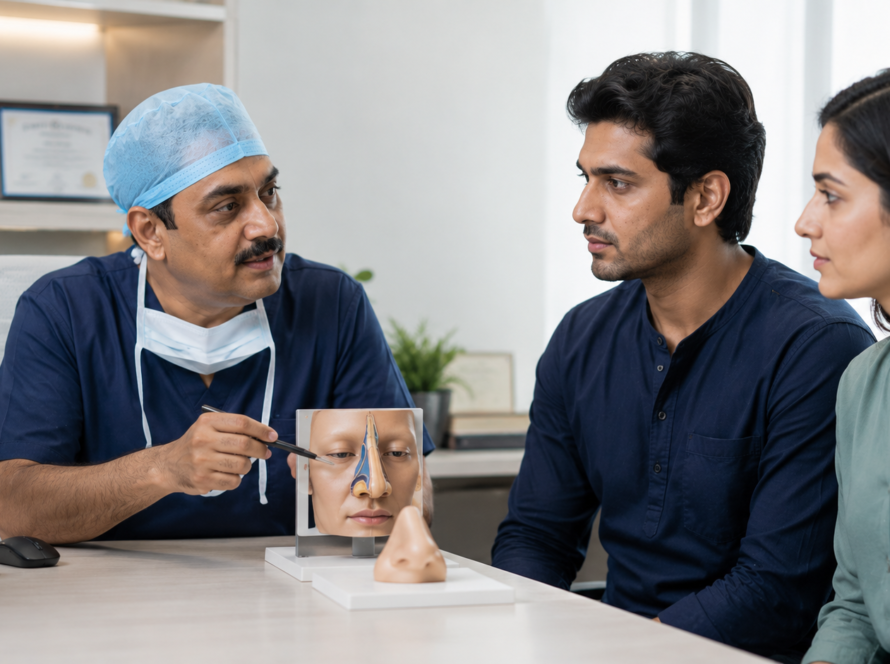
Expert Guidance By: Dr. Ashutosh Shah, M.Ch., DNB (Plastic Surgery)
Specialty: Plastic, Reconstructive & Cosmetic Surgery
Experience: 22+ Years
Position: Founder & Director, Elegance Clinic, Surat
Last Updated: August 2026
A low or flat nose bridge can affect the way the nose looks from both the front and side. For some people, it is simply part of their natural facial anatomy. In others, bridge irregularity may develop after an injury, previous surgery or structural changes within the nose.
Nose bridge correction is not one single procedure. Depending on the problem, treatment may involve surgical rhinoplasty, cartilage grafting or, for carefully selected cosmetic concerns, a nonsurgical approach.
At Elegance Clinic in Surat, the nose is assessed in relation to the rest of the face before deciding whether bridge correction is appropriate.
Key Takeaways
- The nose bridge is also called the nasal dorsum.
- A bridge may appear low, flat, wide, crooked or irregular.
- Treatment should match the specific structural problem.
- Rhinoplasty can make structural changes to the nasal bridge.
- Cartilage grafts may be required for selected augmentation procedures.
- Minor contour irregularities may sometimes be camouflaged nonsurgically.
- Nose filler adds volume, so it cannot make a genuinely large nose smaller.
- Breathing problems should be assessed separately from cosmetic concerns.
- Natural-looking correction should complement the patient’s existing facial proportions.
What Is the Nose Bridge?
The nose bridge is the upper and middle portion of the nose extending downward from between the eyes and forming an important part of the nasal profile.
Doctors commonly refer to this region as the nasal dorsum.
Its appearance depends on several anatomical structures, including:
- nasal bones,
- cartilage,
- septal support,
- skin thickness,
- and surrounding soft tissue.
Because these structures vary naturally, there is no single ideal bridge height that suits every face.
What Is Considered a Low Nose Bridge?
A low nose bridge means the dorsum has relatively limited projection from the face.
Some people naturally have a flatter nasal profile without any medical problem.
A low bridge only becomes an aesthetic concern when the individual feels it affects facial proportions or nasal definition.
Treatment should therefore be based on the person’s anatomy and goals rather than trying to create the same nose shape for everyone.
Why Can the Nose Bridge Look Flat or Uneven?
Several factors may influence bridge shape.
These include:
- inherited nasal anatomy,
- low bony or cartilaginous projection,
- previous nasal trauma,
- developmental differences,
- previous surgery,
- cartilage weakness,
- or structural asymmetry.
A nose that appears “flat” may also have a different underlying issue from one that looks crooked.
This distinction matters when planning treatment.
What Other Nose Bridge Problems Can Occur?
Not every patient seeking nose bridge correction wants additional height.
Some may have:
- a dorsal hump,
- a crooked bridge,
- a wide bridge,
- an irregular profile,
- post-traumatic deformity,
- or asymmetry.
Elegance Clinic’s nasal dorsum correction service discusses structural deviations involving the septum, nasal bones and cartilaginous mid-vault.
A detailed assessment helps determine which structure is actually producing the visible problem.
How Can a Low Nose Bridge Be Corrected?
Treatment generally falls into two broad categories:
Surgical correction changes the underlying nasal framework.
Nonsurgical correction mainly camouflages selected contour problems without reconstructing the framework.
The appropriate choice depends on how much change is required and whether there is a functional problem.
Nose Bridge Correction Options
| Concern | Possible Treatment Direction |
|---|---|
| Low or flat bridge | Surgical augmentation may be considered |
| Mild contour irregularity | Filler may sometimes provide camouflage |
| Crooked nasal dorsum | Structural rhinoplasty may be required |
| Prominent dorsal hump | Surgical reduction may be appropriate |
| Previous traumatic deformity | Reconstructive rhinoplasty may be considered |
| Breathing problem with deviation | Functional and structural assessment is needed |
| Minor temporary bridge enhancement | Selected nonsurgical treatment may be discussed |
This table is only a general guide. Examination is necessary before deciding which option is suitable.
Can Rhinoplasty Correct a Low Nose Bridge?
Yes, surgical rhinoplasty can increase bridge projection in appropriately selected patients.
Rhinoplasty at Elegance Clinic can involve modification of nasal bone, cartilage or both depending on the patient’s anatomy.
For a low bridge, surgery may focus on creating additional structural support or projection.
The objective should be proportional improvement rather than simply making the bridge as high as possible.
What Is Nose Bridge Augmentation?
Nose bridge augmentation involves increasing the height or projection of the nasal dorsum.
Depending on the patient’s anatomy, a surgeon may consider cartilage or another appropriate reconstructive strategy.
The material and technique need to be selected individually.
A well-planned augmentation should transition naturally from the forehead into the nasal bridge rather than creating an abrupt or artificial profile.
Is Cartilage Used for Nose Bridge Correction?
Cartilage grafting may be used during selected rhinoplasty procedures.
Potential cartilage sources can include tissue from the patient’s own nose, ear or rib depending on how much support is required and the reconstructive goal.
Not every patient requires a graft.
The surgeon needs to consider:
- amount of augmentation,
- existing septal cartilage,
- skin thickness,
- previous surgery,
- structural stability,
- and desired shape.
Can a Crooked Nose Bridge Be Straightened?
A crooked bridge may require more complex treatment than simple augmentation.
The nasal bones, septum and cartilage can all contribute to deviation.
Correcting only the visible surface without addressing the underlying framework may not adequately straighten a significantly deviated nose.
Elegance Clinic also provides treatment for crooked nose correction when multiple nasal structures contribute to deviation.
Can Nose Bridge Correction Improve Breathing?
Sometimes, but only when the breathing problem is related to correctable nasal structure.
Cosmetic bridge height alone does not determine airflow.
If someone has nasal obstruction, the doctor may need to assess the septum, internal nasal valves and other airway structures.
Functional concerns should be discussed during the initial consultation rather than assuming cosmetic rhinoplasty will automatically improve breathing.
Can Nose Filler Correct a Low Bridge?
Dermal filler can sometimes add temporary projection to selected areas of the bridge.
This may create the visual appearance of a straighter or more defined profile without changing the underlying bone or cartilage.
However, filler works by adding volume.
It cannot physically narrow nasal bones, remove a large hump or permanently reconstruct a low nasal framework.
Can Nose Filler Make the Nose Smaller?
No.
This is an important limitation.
Filler adds material.
Strategically adding volume can sometimes camouflage an irregularity and make the profile appear more balanced, but the physical nose is not being made smaller.
Patients whose main goal is genuine size reduction generally need to discuss surgical options.
Is Surgical or Nonsurgical Bridge Correction Better?
Neither is automatically better.
Surgery may be more appropriate when the patient wants:
- permanent structural change,
- significant augmentation,
- hump reduction,
- correction of major deviation,
- narrowing,
- or functional reconstruction.
A nonsurgical procedure may be considered when the concern is relatively minor and can be improved by adding or redistributing visible contour.
The decision depends on what actually needs to change.
What Does a Natural Nose Bridge Look Like?
There is no universal measurement that defines a natural-looking nose.
Bridge height should be evaluated together with:
- forehead,
- eyes,
- cheeks,
- nasal tip,
- lips,
- chin,
- and overall facial proportions.
A technically straight bridge can still look unnatural if it is disproportionate to the rest of the face.
Good rhinoplasty planning therefore focuses on facial harmony rather than one isolated measurement.
What Happens During Nose Bridge Assessment?
The surgeon examines the nose from multiple angles.
Assessment may include:
- bridge height,
- bridge width,
- dorsal contour,
- nasal bones,
- septal position,
- tip projection,
- skin thickness,
- symmetry,
- breathing,
- and previous injury or surgery.
Photographs may also be useful for planning and discussing realistic goals.
What Is Recovery After Surgical Nose Bridge Correction?
Recovery depends on the extent of surgery.
Temporary swelling and bruising can occur after rhinoplasty.
The nose may also look swollen or less defined during early healing, so the final contour should not be judged immediately.
Swelling gradually improves, while subtle refinement can continue over a longer period.
Patients should follow their surgeon’s instructions regarding activity, nasal care and follow-up.
Are There Risks?
All surgery carries potential risks.
These can include:
- bleeding,
- infection,
- swelling,
- scarring,
- asymmetry,
- contour irregularity,
- breathing changes,
- altered sensation,
- graft-related problems,
- and dissatisfaction with appearance.
Revision surgery may occasionally be required.
Individual risks should be discussed before treatment.
Nose Bridge Correction at Elegance Clinic, Surat
At Elegance Clinic, patients can be evaluated for both cosmetic and structural nasal concerns.
Dr. Ashutosh Shah is a Plastic, Reconstructive and Cosmetic Surgeon with M.Ch. and DNB qualifications and more than 22 years of surgical experience.
Patients considering rhinoplasty can learn about Dr. Ashutosh Shah and Elegance Clinic before choosing treatment.
Correct the Bridge Without Losing Your Natural Facial Character
Nose bridge correction should not simply aim for a higher or perfectly straight nose.
The more important goal is creating a bridge that works with the tip, forehead, chin and overall face while maintaining appropriate nasal function.
If you are concerned about a low, flat, crooked or uneven nose bridge, a structural assessment can clarify whether surgery or a more conservative approach is appropriate.
Patients in Surat can contact Elegance Clinic for an individual nose assessment.
Frequently Asked Questions
Yes. Surgical augmentation or selected nonsurgical treatments may be considered depending on the anatomy.
Surgical structural correction can provide long-lasting change, while filler-based correction is temporary.
Filler may temporarily add projection in selected patients, but it does not permanently change the nasal framework.
Yes, but significant deviation may require structural rhinoplasty.
Even a relatively small nasal change can influence facial balance, so treatment should be planned in proportion to other facial features.