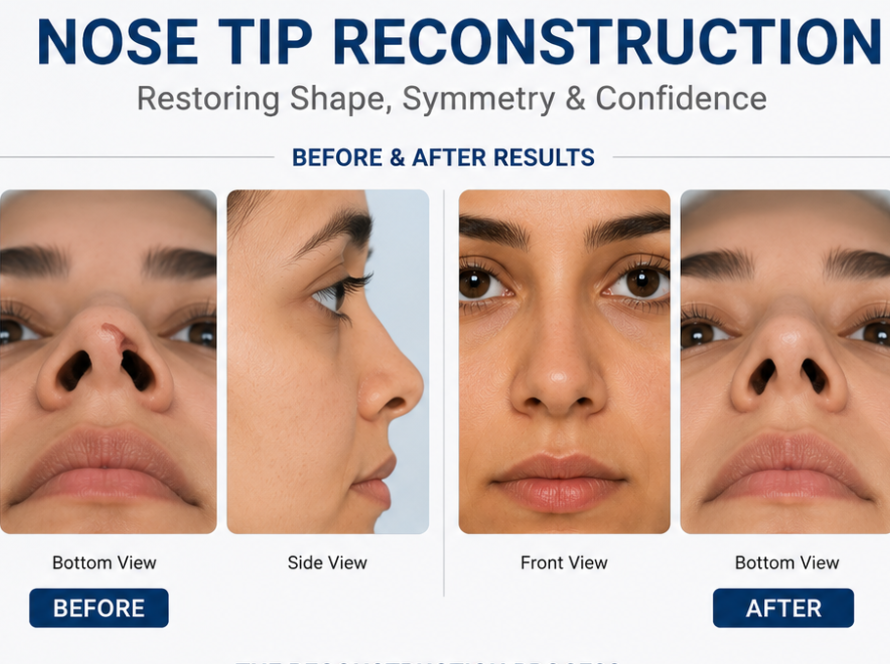
Indian Rhinoplasty: What Is the Goal?
Indian rhinoplasty, often called ethnic rhinoplasty, aims to refine the nose while keeping it balanced with the patient’s existing facial features. Indian noses vary considerably, but some patients may have thicker skin, softer cartilage, a lower bridge, a wider nasal base or less tip definition.
The goal is not to create one standardized “Indian nose” or copy another person’s appearance. Instead, the surgeon evaluates the individual anatomy and creates a result that fits the face while maintaining appropriate nasal function and structural support.
How are Indian noses anatomically different?
There is no single Indian nasal anatomy. Depending on the individual, features may include:
- Thicker or more sebaceous skin
- Softer tip cartilage
- A lower nasal bridge
- A wider nasal base
- A less-defined or rounded tip
- Differences in nostril shape
- Different levels of tip projection
These characteristics are not present in every Indian patient. A proper assessment should consider skin thickness, cartilage strength, bridge height, tip projection, nasal base, facial proportions and breathing.
For some patients, the challenge is not simply removing tissue. Additional structural support may be needed to achieve controlled refinement.
Why does reduction-only rhinoplasty often fail on Indian noses?
Reduction-only rhinoplasty is not automatically inappropriate, but excessive removal of cartilage or bone can weaken nasal support.
For a patient with softer cartilage or thicker skin, simply reducing the tip may not create the desired definition. In some cases, the surgeon may need to strengthen or reshape the framework rather than only remove tissue.
This is why a structural-first approach can be useful in selected patients. The surgeon considers what should be reduced, repositioned, supported or rebuilt.
The aim is controlled refinement rather than aggressive reduction.
Which techniques build definition without an over-operated look?
Several techniques may be considered depending on the anatomy.
Tip refinement: Carefully placed sutures and cartilage techniques can improve tip shape and projection.
Cartilage grafting: Septal, ear or rib cartilage may provide additional support when needed. Rib cartilage is not automatically required.
Dorsal augmentation: A low bridge may sometimes be increased using cartilage or another appropriate material.
Alar base modification: When the nasal base is genuinely wide, selective narrowing may improve proportions.
Septal correction: If deviation or structural weakness affects breathing or support, septal surgery may be incorporated into the plan.
The appropriate technique depends on the patient’s anatomy rather than ethnicity alone.
Patients interested in a natural-looking rhinoplasty can also review how facial proportions influence surgical planning.
How is the target shape chosen for an Indian face?
The target nose should be planned in relation to the entire face.
The surgeon may assess:
- Facial width and proportions
- Forehead-to-nose relationship
- Chin projection
- Nasal length
- Bridge height
- Tip projection
- Nasolabial angle
- Nasal base width
- Breathing function
Computer imaging can help communicate an intended direction, but it cannot guarantee the final surgical result.
The important question is not, “How small can the nose become?” It is, “What nasal proportions will look balanced on this particular face?”
A physician-reviewed planning principle is to use facial proportion analysis together with the patient’s preferences when deciding the target shape.
What should you ask to avoid an unnatural result?
Before surgery, ask:
- What specifically makes my nose look unbalanced?
- Is my nasal skin thin, medium or thick?
- How strong is my tip cartilage?
- Do I need reduction, structural support or both?
- Will the proposed surgery affect my breathing?
- Will cartilage grafting be necessary?
- If grafting is needed, where will the cartilage come from?
- What degree of narrowing is realistic?
- How long might tip swelling remain?
- Can you show results from patients with similar anatomy?
A good surgical plan should explain why a technique is being recommended rather than simply promising a particular nose shape.
For patients concerned about nasal width, wide nose rhinoplasty provides more information about possible approaches.
Indian Rhinoplasty: Feature-to-Technique Guide
| Common feature | Why it matters | Usual technique | Realistic change |
|---|---|---|---|
| Thick skin | Can make fine tip definition more difficult to show | Structural support and controlled tip refinement when appropriate | Better contour, but not necessarily an extremely sharp tip |
| Low bridge | Can make the profile appear flatter | Dorsal augmentation when indicated | Increased bridge height and improved profile balance |
| Wide alar base | Can make the nose appear broader from the front | Selective alar base reduction when appropriate | Reduced excessive width while maintaining natural nostril shape |
| Soft tip | May limit projection and definition | Tip sutures and/or cartilage support | Improved projection and controlled tip shape |
These features do not automatically require surgery. The technique should follow the patient’s actual anatomy.
Will rhinoplasty make my nose look Western?
No. Rhinoplasty does not have to produce a stereotypically Western-looking nose.
A natural Indian nose job can focus on facial harmony, appropriate proportions and the patient’s own aesthetic goals.
The question will rhinoplasty change my ethnic look is best answered during individual surgical planning. The degree of change depends on the starting anatomy, technique and desired result.
Ethnic rhinoplasty is not one universal procedure. Individual anatomy varies considerably, even among people from the same ethnic background.
Can a wide Indian nose be narrowed naturally?
Yes, when the anatomy is suitable.
The surgeon may need to address the nasal bones, cartilage, tip or alar base depending on where the width originates.
The objective is controlled narrowing rather than making the nose excessively narrow or pinched.
A balanced result should look appropriate from both the front and side.
Is rib cartilage needed for Indian rhinoplasty?
Not routinely.
Septal or ear cartilage may be sufficient for some primary procedures. Rib cartilage can be considered when substantial structural support or augmentation is required, including selected revision cases.
The decision depends on the amount of support required, available cartilage and the overall surgical plan.
How long does tip swelling last with thick skin?
Tip swelling can take longer to settle in patients with thicker skin. Early swelling generally improves progressively, but the final definition may continue developing for many months.
This does not mean that the final result will be poor. It means patients should have realistic expectations about the healing timeline.
For patients researching rhinoplasty thick skin indian anatomy, it is particularly important to understand that skin thickness can influence how quickly the underlying structural refinement becomes visible.
Can a low bridge be raised without an implant?
Sometimes.
Depending on the patient’s anatomy and the amount of augmentation required, cartilage from the septum, ear or rib may be considered.
The appropriate option depends on the amount of projection required, available tissue and the surgeon’s assessment.
For more information about bridge correction, see nasal dorsum correction.
Is ethnic rhinoplasty more expensive?
It can be, depending on the complexity of surgery, grafting requirements, anesthesia, facility charges and whether functional or revision work is required.
Rhinoplasty Cost In Gujarat: What Determines The Price?
For patients researching rhinoplasty cost in gujarat, the most useful comparison is not simply the lowest quoted price. Ask what the surgical fee includes and whether anesthesia, facility charges, grafting and follow-up are included.
A straightforward primary rhinoplasty can have a different cost from a structural rhinoplasty requiring extensive grafting or a revision procedure.
The final estimate should be discussed after an examination and individualized surgical plan.
What Is Ethnic Rhinoplasty in India?
Ethnic rhinoplasty in india means planning rhinoplasty while taking the patient’s existing anatomy, facial proportions and desired appearance into account.
It does not mean every patient receives the same operation.
For some patients, structural support and augmentation may be more important than aggressive reduction. For others, the main concern may be a hump, deviation, wide base, low bridge or another specific feature.
The aim is to create a nose that looks naturally integrated with the rest of the face.
Frequently Asked Questions
No. Rhinoplasty does not have to produce a stereotypically Western-looking nose. The goal can be to refine the nose while preserving facial proportions and features that suit the patient’s face.
Yes. Depending on the source of the width, the surgeon may address the nasal bones, cartilage, tip or alar base. The aim is controlled narrowing without making the nose look pinched or disproportionate.
Not routinely. Septal or ear cartilage may be sufficient for some patients. Rib cartilage may be considered when substantial structural support or augmentation is required, particularly in selected primary or revision cases.
Tip swelling can take longer to settle in patients with thicker skin. Early swelling usually improves progressively, but nasal definition can continue to develop for many months as the tissues heal.
Sometimes. Depending on the anatomy and amount of augmentation required, cartilage from the septum, ear or rib may be considered. The appropriate option depends on the required projection and structural support.
It can be, depending on surgical complexity, grafting requirements, anesthesia, facility charges and whether functional or revision work is needed. The final cost should be discussed after an examination and individualized surgical plan, including rhinoplasty cost in gujarat.
Featured Questions
Can rhinoplasty keep my Indian features and still make my nose look refined?
Yes. The surgical goal can be a more balanced and defined nose while preserving proportions and characteristics that suit the patient’s face.
What is ethnic rhinoplasty and is it different for Indian noses?
Ethnic rhinoplasty is individualized rhinoplasty that considers the patient’s anatomy, facial proportions and desired appearance rather than applying one standard nasal shape.
How do I avoid a fake-looking nose job in India?
Discuss realistic proportions, structural support, breathing, skin thickness and the degree of change before surgery. Ask how the proposed shape will relate to the rest of your face.
Final Takeaway
The best ethnic rhinoplasty is not necessarily the most dramatic one. It is the procedure that improves the features the patient wants to change while maintaining facial balance, nasal function and structural stability.
For patients with thicker skin, softer cartilage, a low bridge or a wider base, structural planning may be particularly important. However, there is no universal technique for every Indian nose.
The goal should be a nose that looks refined, balanced and naturally yours.