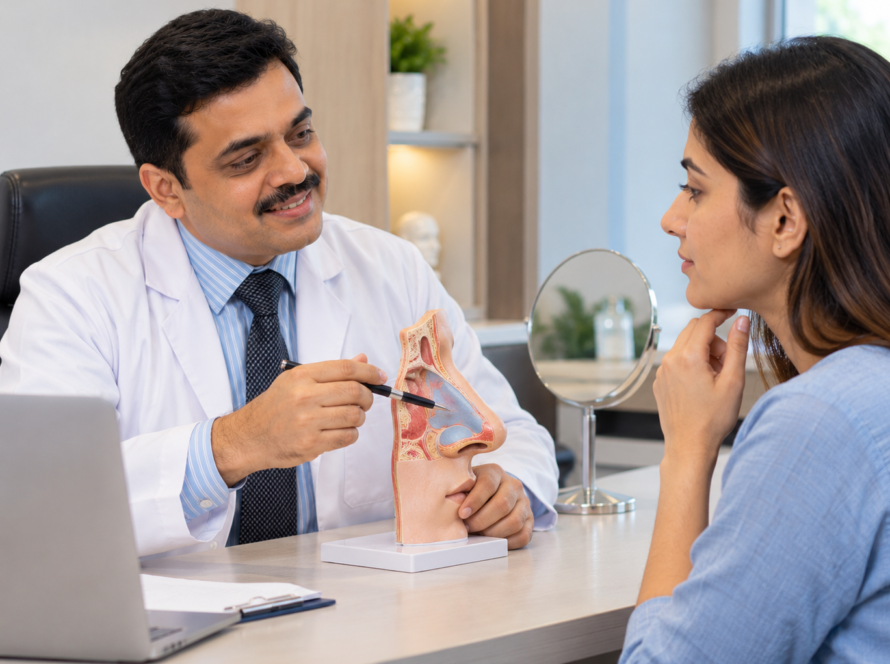
Rhinoplasty is surgery to reshape the nose or correct selected structural problems affecting nasal function. Patients travelling from Ahmedabad generally begin with a consultation, undergo necessary medical assessments and arrange surgery on an appropriate date. Before deciding, they should understand the expected results, recovery period, travel requirements and follow-up schedule.
Planning nose surgery away from home requires more than booking an operation. Patients need sufficient time for examination, postoperative monitoring and safe travel after discharge.
For treatment details, see rhinoplasty surgery in Surat.
Quick Facts: Rhinoplasty
| Detail | General guidance |
|---|---|
| Procedure duration | Often 1.5–3 hours; [surgeon to confirm] |
| Anaesthesia | Usually general anaesthesia |
| Hospital stay | Day care or overnight observation, depending on the case; [surgeon to confirm] |
| Back to desk work | Commonly 1–2 weeks; [surgeon to confirm] |
| Initial recovery | Approximately 2–3 weeks |
| Follow-ups | Early review and subsequent appointments; [surgeon to confirm schedule] |
| Final results | Often 6–12 months or longer |
| Travel after surgery | Only after individual medical clearance |
Key Takeaways
- Rhinoplasty may improve nasal shape, proportions, symmetry or selected breathing-related concerns.
- Patients should complete consultation and medical assessment before finalising surgery.
- Initial recovery commonly requires one to two weeks away from desk work.
- Swelling improves gradually, while final nasal refinement may take a year or longer.
- Procedure complexity, anaesthesia and hospital charges affect the cost.
- Travelling patients should arrange accommodation, assistance and follow-up appointments.
- Individual surgical suitability and travel clearance must be confirmed by the surgeon.
What is rhinoplasty and who is it for?
Rhinoplasty, commonly called nose reshaping surgery, changes the nasal bone, cartilage or supporting tissues to address specific concerns.
Patients may consider it for a prominent nasal hump, broad nasal tip, drooping tip, asymmetry, changes following injury or certain structural problems affecting breathing.
Surgery can be cosmetic, functional or a combination of both. However, not every breathing problem requires rhinoplasty.
Who may be suitable?
Suitable candidates are generally adults in good health with realistic expectations and concerns that can reasonably be addressed through surgery.
The surgeon evaluates nasal anatomy, skin thickness, breathing, previous injuries, medical conditions and earlier operations.
Patients should disclose smoking, nicotine use, medicines and allergies because these may affect anaesthesia or healing.
People considering nose surgery should understand that rhinoplasty aims for an individualised improvement rather than an identical appearance for every patient.
Patients who have undergone previous nasal surgery may need a more detailed assessment. The clinic’s revision rhinoplasty page explains considerations for repeat procedures.
How the procedure is done, step by step
Rhinoplasty techniques vary according to nasal anatomy and the planned correction. The following steps explain the usual treatment process.
Step 1: Consultation
The surgeon discusses the patient’s concerns, examines the nose and evaluates breathing.
Medical photographs may be taken with consent to support treatment planning.
Step 2: Investigations and preparation
Blood tests, anaesthesia assessment or additional investigations may be recommended according to the patient’s medical history.
The team provides instructions about medicines, fasting and preparation before surgery.
Step 3: Anaesthesia
Most rhinoplasty operations are performed under general anaesthesia. The anaesthetist explains the appropriate approach and monitoring.
Step 4: Nasal reshaping
The surgeon may use an open or closed technique.
Open rhinoplasty generally involves an incision across the columella and additional internal incisions. Closed rhinoplasty uses incisions inside the nostrils.
The surgeon adjusts bone, cartilage or supporting structures according to the treatment plan. Cartilage grafts may be required in selected cases.
Step 5: Closure and support
Incisions are closed, and a splint or dressing may be applied to support healing.
Step 6: Postoperative monitoring
The patient is monitored after anaesthesia and receives instructions about medicines, nasal care, activity restrictions and follow-up appointments.
For information about incision placement, read rhinoplasty scar guidance.
Recovery: what the first weeks look like
Rhinoplasty recovery involves gradual improvement in swelling, bruising, congestion and tenderness.
| Period | Expected recovery | Patient guidance |
|---|---|---|
| First 48 hours | Swelling, congestion and discomfort | Rest and elevate the head as advised |
| Days 3-7 | Bruising and swelling may remain noticeable | Avoid strenuous activity and nasal pressure |
| Days 7-10 | Early healing assessment | Attend the scheduled review |
| Week 2 | Bruising often improves | Resume desk work if cleared |
| Weeks 3-4 | Swelling continues reducing | Protect the nose from injury |
| Weeks 4-6 | Gradual activity progression | Exercise only with medical approval |
| Months 3-12+ | Nasal contours continue refining | Attend longer-term reviews |
What should patients avoid?
During early recovery, patients are commonly advised to avoid heavy lifting, strenuous exercise, forceful nose blowing and activities that could injure the nose.
Head elevation may help manage swelling. Glasses and contact sports may require temporary restrictions.
Smoking and nicotine can interfere with wound healing and should be avoided according to medical instructions.
When should patients seek help?
Contact the surgical team for worsening pain, fever, spreading redness, unusual discharge or persistent bleeding.
Heavy uncontrolled bleeding, breathing difficulty or sudden visual changes require emergency assessment.
The American Society of Plastic Surgeons notes that initial swelling decreases over weeks, while final nasal refinement can continue for up to a year or longer.
Which factors change the cost?
Rhinoplasty costs vary because patients may require different surgical techniques, operating times and hospital services.
The main factors include:
Surgical complexity: Primary reshaping, functional correction and revision surgery can require different levels of planning.
Anaesthesia and hospital facilities: Operating theatre charges, anaesthesia fees, monitoring and hospital stay affect the total.
Grafting or combined correction: Cartilage grafts or additional structural procedures may increase complexity and expense.
What should a quotation include?
| Cost component | What to confirm |
|---|---|
| Surgeon fee | Full surgical procedure |
| Anaesthesia | Anaesthetist and medication charges |
| Hospital | Theatre, room and monitoring |
| Investigations | Required preoperative tests |
| Medicines | Postoperative prescriptions |
| Follow-ups | Included appointments |
| Additional care | Charges for unexpected treatment |
Patients should also budget for accommodation, transport and time away from work.
Avoid comparing advertised prices without checking what each quotation covers.
How patients plan rhinoplasty in ahmedabad and travel for surgery
Patients living in Ahmedabad can organise their consultation and treatment in stages to reduce unnecessary journeys while maintaining safe postoperative care.
1. Arrange the initial consultation
Contact the clinic and explain the nasal concern, previous treatment history and preferred appointment dates.
An initial online discussion may be available, but an in-person examination is generally necessary before surgery.
2. Complete medical assessment
The surgeon determines whether investigations, breathing assessment or anaesthesia evaluation are required.
Patients should confirm the proposed technique and expected recovery before finalising travel.
3. Arrange accommodation and assistance
Plan for a responsible adult to assist after discharge.
Accommodation should allow access to the surgical facility during early recovery.
[Surgeon to confirm recommended local stay after rhinoplasty.]
4. Schedule postoperative reviews
Early follow-up may involve checking the splint, incisions and healing.
Ask which appointments require in-person attendance and whether later reviews can be conducted remotely.
[Clinic to confirm its standard follow-up schedule.]
5. Obtain travel clearance
The timing of the return journey depends on recovery, bleeding risk, comfort and transport arrangements.
Patients should not assume they can travel immediately after surgery.
[Surgeon to confirm the recommended travel interval.]
For appointments, visit contact nose surgeon in Surat.
Questions to ask before you decide
Before proceeding, discuss these questions with your surgeon:
- Is rhinoplasty appropriate for my concern?
- Will the procedure affect my breathing?
- What improvement is realistic?
- Which surgical technique is recommended?
- Will cartilage grafting be necessary?
- What complications should I understand?
- How long should I stay near the clinic?
- When can I return home?
- How many follow-ups will I need?
- What is included in the quotation?
For additional information about individual nasal proportions and treatment considerations, see the male rhinoplasty guide.
Consultation with Dr. Ashutosh Shah
Dr. Ashutosh Shah (M.S., M.Ch., D.N.B.), associated with Elegance Clinic, provides consultations for plastic, reconstructive and cosmetic surgical concerns.
Patients can discuss their nasal anatomy, surgical suitability, expected recovery, potential risks and follow-up arrangements.
A decision should follow an individual examination, informed consent and realistic discussion of outcomes.
Frequently Asked Questions
Rhinoplasty often takes approximately 1.5-3 hours, although complex procedures can take longer. Additional time is required for preparation, anaesthesia and postoperative monitoring. [Surgeon to confirm usual duration.]
An early review is commonly arranged within the first one to two weeks, followed by additional appointments according to healing. The exact schedule should be confirmed before travelling.
An initial online discussion may be possible if offered by the clinic. However, a physical examination and appropriate preoperative assessment are generally necessary before surgery.
Travel should occur only after the surgeon confirms that recovery is progressing safely. Patients planning rhinoplasty in ahmedabad should allow time for early postoperative assessment before returning home.
Most early swelling improves within weeks, but the nasal contour continues changing for several months. Final results may take 6-12 months or longer.
Additional Questions for Ahmedabad Patients
Where can I get rhinoplasty near Ahmedabad?
Patients may consider qualified surgeons and appropriately equipped facilities, including those outside their home city. Review credentials, hospital arrangements and follow-up accessibility.
What is the process of rhinoplasty?
The process generally includes consultation, examination, medical investigations, anaesthesia assessment, surgery, initial recovery and scheduled reviews.
How should I plan rhinoplasty if I live in Ahmedabad?
Arrange consultation and investigations first, then plan surgery, accommodation, time away from work and postoperative visits. Confirm travel clearance before returning home.
Conclusion
Rhinoplasty requires individual planning, realistic expectations and sufficient recovery time. Patients travelling from Ahmedabad should prioritise surgical assessment, safe postoperative accommodation and reliable follow-up care.
At Elegance Clinic, Dr. Ashutosh Shah can assess nasal concerns and discuss appropriate treatment options.
Have questions about your situation? Contact the clinic to discuss rhinoplasty consultation, surgery planning and follow-up arrangements.