A small sore on your nose may seem harmless. However, a wound that repeatedly bleeds, crusts or refuses to heal deserves medical attention. Sometimes, these changes indicate basal cell carcinoma (BCC), the most common type of skin cancer.
Basal cell carcinoma on nose treatment usually involves removing the cancer while preserving as much healthy tissue as possible. The surgeon must also check whether cancer cells remain at the edges of the removed tissue.
This step matters because the nose has limited spare skin. In addition, its shape supports normal breathing and facial appearance.
Doctors may use standard excision, frozen-section margin assessment or Mohs micrographic surgery. Once the surgical team confirms clear margins, they can plan the final repair.
This guide explains how these methods differ, when reconstruction becomes necessary and what patients should expect during recovery.
What Does Basal Cell Carcinoma on the Nose Look Like?
Basal cell carcinoma develops from cells in the outer layers of the skin. It often appears on areas that receive years of sun exposure, including the nose.
However, BCC does not always look the same.
Common Signs of BCC
Possible signs include:
- A shiny or pearly bump
- A pink, red or skin-coloured growth
- A small sore that repeatedly bleeds
- A crusted patch that does not heal
- Fine blood vessels across a raised lesion
- A scar-like patch without a clear injury
- A gradually enlarging spot
In darker skin tones, some lesions may appear brown, black or pigmented.
A non healing sore on nose should not automatically be treated as a simple infection. Instead, a dermatologist or qualified surgeon should examine it.
Does Every Nose Lesion Mean Cancer?
No. Acne, cysts, infections and inflammatory skin conditions can produce similar changes.
However, appearance alone cannot confirm the diagnosis.
A clinician may use dermoscopy to examine the lesion more closely. They may also recommend a biopsy.
The biopsy allows a pathologist to examine the tissue under a microscope and identify the type of lesion.
Why Are Clear Surgical Margins Important?
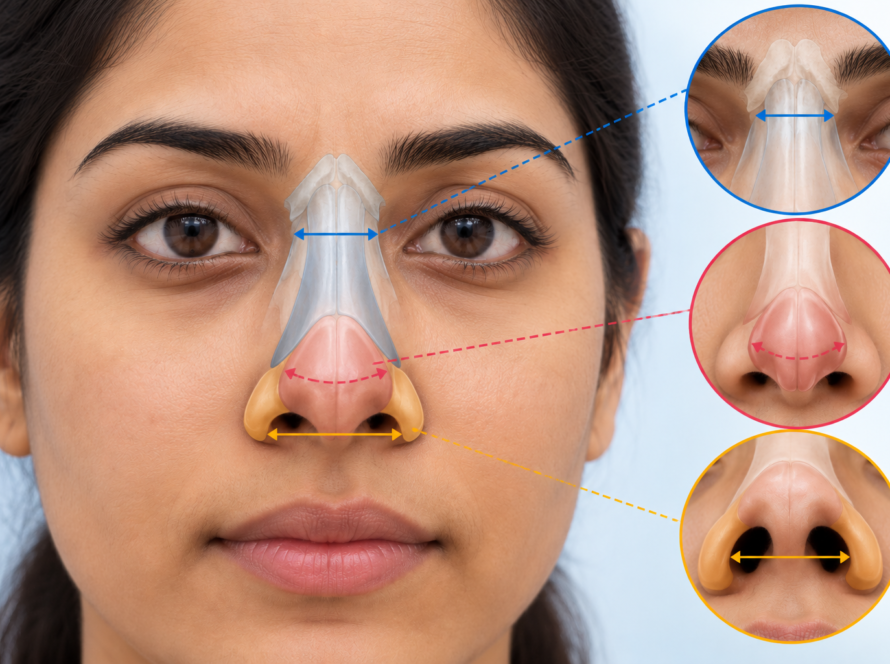
The nose contains several small anatomical structures. These include the nasal tip, bridge, sidewalls, nostrils and alar rims.
Therefore, removing a skin cancer requires careful planning.
What Is a Surgical Margin?
A surgical margin refers to the tissue surrounding the visible tumour that the surgeon removes during treatment.
The goal is to remove the cancer completely while preserving healthy skin.
However, some BCC cells extend beyond the visible edge of the lesion.
Consequently, a surgeon cannot always judge complete removal by appearance alone.
What Does a Clear Margin Mean?
A pathologist examines the removed tissue to determine whether cancer cells reach the surgical edges.
A clear or negative margin means the examination found no tumour at the assessed edges.
However, different techniques examine different proportions of the margin.
For example, standard histology usually samples selected sections. In contrast, Mohs surgery evaluates nearly the entire peripheral and deep surgical margin through a mapped technique.
This difference helps explain why surgeons may recommend different approaches for different tumours.
Why Does Margin Control Matter on the Nose?
The nose belongs to a high-risk anatomical area for BCC management.
Moreover, some tumours have poorly defined borders or aggressive growth patterns.
Therefore, careful margin assessment can help reduce the risk of leaving cancer behind.
It also helps the surgeon avoid removing unnecessary healthy tissue.
For more information, read about basal cell carcinoma treatment.
How Do Standard Excision, Frozen Section and Mohs Surgery Differ?
Doctors choose a treatment according to tumour size, location, biopsy findings and previous treatment history.
The three main surgical approaches differ in how they assess the removed tissue.
Standard Surgical Excision
During standard excision, the surgeon removes the visible cancer with a planned margin of surrounding tissue.
Next, the laboratory examines the specimen using permanent histology.
This process usually takes several days, depending on the laboratory.
Standard excision may suit selected small, well-defined tumours. However, the surgeon must consider the higher-risk location of nasal lesions.
If pathology identifies involved margins, the patient may need further treatment.
Frozen-Section Margin Assessment
Frozen-section analysis allows a pathologist to examine tissue during surgery.
The surgeon removes the lesion and sends tissue for rapid processing.
Next, the pathologist checks the submitted sections for cancer cells.
If the examination identifies an involved margin, the surgeon may remove additional tissue.
However, the accuracy depends on the sampling method, tissue orientation and pathology expertise.
Frozen-section analysis does not automatically provide the same comprehensive margin assessment as Mohs surgery.
Mohs Micrographic Surgery
Mohs surgery removes skin cancer in carefully mapped stages.
First, the surgeon removes a thin layer of tissue.
Next, the laboratory processes the tissue so the surgeon can examine nearly the entire peripheral and deep margin.
If cancer remains, the surgeon removes another layer from the affected area.
The process continues until the examined margins show no remaining tumour.
Mohs surgery offers precise margin control and helps conserve healthy tissue. Therefore, clinicians often consider it for BCC in high-risk areas such as the nose.
However, not every patient needs Mohs surgery, and availability varies by centre.
Margin-Control Comparison Table
| Method | How Margins Are Checked | Same-Day Reconstruction Possible? | Common Situations |
|---|---|---|---|
| Standard excision | Permanent histology examines selected tissue sections | Yes, in selected cases, although repair may wait for pathology | Selected well-defined primary BCCs |
| Excision with frozen sections | Pathologist examines submitted frozen tissue sections during surgery | Often possible when the team confirms adequate clearance | Cases where intraoperative margin assessment is appropriate |
| Mohs surgery | Mapped examination of nearly all peripheral and deep margins | Often possible after clear margins | High-risk nasal BCC, recurrent tumours and poorly defined lesions |
Important: The method should match the tumour’s risk. The treating team should establish adequate histological clearance before complex definitive nasal reconstruction whenever feasible.
Is Mohs Surgery Better Than Normal Excision?
Mohs surgery offers detailed margin control while preserving healthy tissue.
This benefit matters on the nose because even a small amount of removed skin can affect its shape.
However, treatment selection depends on more than location.
When Might Mohs Be Preferred?
A clinician may recommend Mohs surgery when the tumour:
- Has poorly defined borders
- Has returned after previous treatment
- Shows aggressive features on biopsy
- Lies near a sensitive nasal structure
- Requires maximum healthy-tissue preservation
Nevertheless, standard excision with appropriate margin assessment remains a valid option for selected patients.
What If Mohs Surgery Is Not Available?
The surgeon may consider standard excision with permanent histology or an appropriately planned frozen-section approach.
However, the team should explain how they will check margins.
Patients should also ask what happens if pathology finds remaining cancer.
The priority is complete tumour removal with an appropriate method of margin assessment.
How Is the Nose Rebuilt After Skin Cancer Removal?
After removing the tumour, the surgeon examines the resulting defect.
Some wounds are small enough for direct closure. Others need a skin graft or flap.
Therefore, the repair depends on the size, depth and location of the missing tissue.
Step 1: Direct Closure
Direct closure involves bringing the wound edges together with stitches.
This option may suit small defects when enough nearby skin remains.
However, excessive tension can distort the nostril or nasal tip.
Therefore, the surgeon must assess the surrounding tissue carefully.
Step 2: Local Flap Reconstruction
A local flap uses nearby skin that retains its blood supply.
The surgeon moves this tissue into the defect.
For example, certain nasal sidewall or tip defects may benefit from a carefully planned local flap.
The technique can provide a close match in skin colour and texture.
However, flap design must respect the nose’s natural shape and blood supply.
Read more about when nose flap surgery is needed.
Step 3: Skin Graft Reconstruction
A skin graft transfers skin from another part of the body.
Unlike a flap, the graft does not retain its original blood supply. Instead, it must develop a new blood supply from the wound bed.
Skin grafts may suit selected superficial nasal defects.
However, they may differ from surrounding nasal skin in colour, texture or contour.
Step 4: Forehead Flap Reconstruction
Large or complex nasal defects may require a forehead flap.
This technique uses skin from the forehead to rebuild missing nasal tissue.
The surgeon may perform the reconstruction in stages.
In some cases, the repair also requires cartilage support or internal lining reconstruction.
Therefore, complex defects need careful planning to preserve both appearance and breathing.
Patients can learn more about nasal reconstruction after cancer.
Nasal Reconstruction Ladder
| Reconstruction Method | Typical Defect | Main Advantage | Important Consideration |
|---|---|---|---|
| Direct closure | Small defect with enough surrounding skin | Uses nearby skin and a relatively simple repair | Tension may distort the nose |
| Local flap | Small to moderate defect | Provides nearby skin with its blood supply | Requires careful flap design |
| Skin graft | Selected superficial defects | Can cover a wound without moving a large flap | Colour or contour may differ |
| Forehead flap | Large or complex defect | Provides tissue for major reconstruction | Often requires staged surgery |
Why Does the Nasal Subunit Matter?
Surgeons divide the nose into aesthetic subunits, such as the tip, dorsum, sidewalls and alae.
These areas have different shapes, contours and skin characteristics.
Therefore, reconstruction should consider the affected subunit rather than wound size alone.
For example, a small defect near the nostril rim may require more complex planning than a similarly sized defect on the upper nasal bridge.
The surgeon must also protect the airway and avoid pulling the nostril out of position.
When Does Reconstruction Happen?
Reconstruction timing depends on the treatment method and margin status.
After Mohs surgery, the team can often repair the wound on the same day once the surgeon confirms clear margins.
Similarly, intraoperative frozen-section assessment may allow immediate reconstruction when the team has adequate confidence in tumour clearance.
However, standard excision may require a delay while the laboratory processes permanent histology.
Why Might a Surgeon Delay Reconstruction?
The surgeon may postpone a complex repair when:
- Margin results remain uncertain
- The tumour has aggressive features
- The wound needs further assessment
- Additional cancer removal may be necessary
- The patient needs staged reconstruction
This approach can prevent the team from placing a complex flap over an area that may still need cancer treatment.
However, selected wounds may undergo immediate repair after standard excision when the surgeon judges the risk acceptable.
The final decision requires individual planning.
What Happens During Recovery?
Recovery depends on the size of the wound and the reconstruction method.
A small direct closure may heal faster than a large staged flap.
However, all patients need proper wound care and follow-up.
During the First Week
Mild swelling, bruising and discomfort may occur.
The surgeon may recommend:
- Keeping the dressing clean
- Avoiding pressure on the nose
- Sleeping with the head elevated
- Taking prescribed medicines
- Attending the scheduled wound review
However, follow the specific instructions from your surgical team.
During Weeks Two to Four
Swelling may gradually improve.
Some patients have stitches removed during this period, although the timing varies.
Additionally, the surgeon checks wound healing and reviews any pending pathology results.
During the Following Months
Scars usually continue changing for several months.
Initially, the scar may look pink, raised or firm.
Over time, it may soften and become less noticeable.
However, the final appearance depends on skin type, wound size, reconstruction technique and healing.
Complex reconstruction may require additional stages or refinements.
What Follow-Up Is Needed After BCC Surgery?
Basal cell carcinoma can return after treatment. In addition, patients who develop one BCC have a higher risk of developing another skin cancer.
Therefore, regular follow-up matters.
Check the Surgical Site
Look for:
- A new bump near the scar
- Repeated bleeding
- A sore that does not heal
- Changes in the scar’s appearance
- New crusting or ulceration
Contact your clinician if you notice these changes.
Protect Your Skin From Sun Exposure
Sun protection helps reduce further ultraviolet damage.
Use suitable protective clothing and shade. In addition, apply broad-spectrum sunscreen to exposed skin according to product instructions.
Avoid excessive sun exposure, especially during peak daylight hours.
Schedule Regular Skin Examinations
Your dermatologist or surgeon will recommend follow-up based on tumour risk and treatment history.
Many patients need periodic full-skin examinations.
Higher-risk or recurrent tumours may require closer monitoring.
For a broader overview, read about nose cancer surgery.
Skin Cancer Surgeon Vapi: What Should You Ask Before Treatment?
If you are searching for a skin cancer surgeon vapi, focus on the clinician’s experience with nasal skin cancer and reconstruction.
A suitable treatment plan should explain how the team will remove the tumour, confirm clear margins and repair the nose.
Questions to Ask During Consultation
Ask your surgeon:
- Has a biopsy confirmed the diagnosis?
- Is the tumour low-risk or high-risk?
- Which margin-control method do you recommend?
- Can the laboratory check margins during surgery?
- Would Mohs surgery offer an advantage?
- Will reconstruction happen immediately or later?
- Could the repair affect nostril shape or breathing?
- What follow-up will I need?
These questions help you understand the treatment process.
Moreover, they clarify whether the surgical team can provide both cancer removal and appropriate reconstruction.
Frequently Asked Questions
Basal cell carcinoma usually grows slowly and rarely spreads to distant organs. However, it can invade nearby tissue and cause significant damage if treatment is delayed. Therefore, a suspicious or confirmed BCC needs timely medical assessment and appropriate treatment.
Certain superficial BCCs may respond to prescribed topical treatments. However, creams are generally less suitable for high-risk nasal lesions, deeper tumours or aggressive BCC types. Surgery with appropriate margin assessment is often preferred for nasal BCC. A clinician should select treatment after reviewing the biopsy and tumour risk.
Most surgical repairs leave some degree of scarring. However, surgeons plan incisions and tissue movement to reduce distortion and improve the final appearance. Scars often change over several months. The result depends on defect size, reconstruction method and individual healing.
Mohs surgery requires specialised training, tissue processing and pathology support. Availability varies between hospitals and specialist centres. Therefore, ask the treating centre whether it offers true Mohs micrographic surgery or another form of margin-controlled excision. These methods are not identical.
Yes. Basal cell carcinoma can recur, especially when a tumour has aggressive features or incomplete removal. However, appropriate treatment with clear margins lowers the risk. Regular follow-up helps identify recurrence or new skin cancers early.
The schedule depends on your tumour’s risk, previous skin cancers and individual health factors. Many patients benefit from periodic full-skin examinations. Higher-risk cases may need more frequent visits. Follow the plan your dermatologist or surgeon recommends.
Treatment commonly involves surgical removal with appropriate margin assessment. The surgeon may recommend standard excision, frozen-section assessment or Mohs surgery. If removal leaves a defect, reconstruction may involve direct closure, a local flap, a skin graft or a forehead flap.
Mohs surgery provides detailed margin assessment while conserving healthy tissue. Therefore, it may offer important advantages for high-risk nasal BCC. However, selected tumours may respond well to standard excision with appropriate histological assessment. The best method depends on tumour characteristics and available expertise.
The surgeon selects the repair according to wound size, depth and location. Small defects may allow direct closure. Other wounds may need a local flap or skin graft. Large defects may require a staged forehead flap and structural support. The goal is to restore nasal appearance and function.
When choosing a skin cancer surgeon vapi, ask about experience with nasal BCC, margin assessment and reconstructive surgery. Also, confirm access to appropriate pathology services and discuss how the team will manage positive margins. A clear treatment and follow-up plan matters more than promotional claims.
Conclusion
Basal cell carcinoma on the nose requires careful treatment because the nose has limited spare tissue and important functional structures.
Standard excision, frozen-section assessment and Mohs surgery offer different methods of removing cancer and checking margins.
Therefore, the surgeon should choose an approach that matches the tumour’s risk and location.
Once the team establishes adequate tumour clearance, reconstruction may involve direct closure, a local flap, a skin graft or a forehead flap.
Most importantly, early diagnosis, appropriate margin control and regular follow-up help protect both nasal function and long-term skin health.