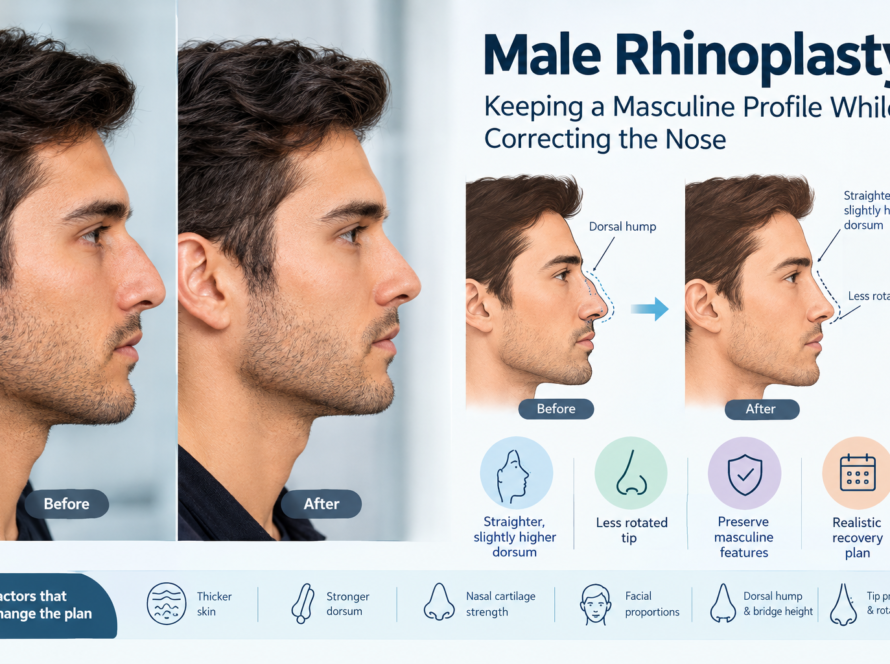
A saddle nose deformity is a structural change in which the middle portion of the nasal bridge loses height and support, creating a depressed or scooped appearance when viewed from the side. The change can be mild or pronounced and may affect both the appearance of the nose and its ability to function normally.
The underlying problem is usually a loss or weakening of the structures that support the nasal dorsum, particularly the nasal septum. Trauma, previous septal surgery, infection and inflammatory disease can all damage this support.
Correction is therefore different from simply making a nose look higher. The surgeon first needs to understand why the bridge collapsed, whether the septum and internal nasal structures are stable, and whether breathing is also affected. Reconstruction may then involve cartilage grafts or other structural techniques to rebuild the missing support.
For patients looking for more information about a depressed nasal bridge, the guide to sunken nose treatment explains how loss of bridge height can be assessed and treated.
What Causes the Nasal Bridge to Collapse Into a Saddle Shape?
The nasal bridge depends on a framework of bone, cartilage and septal support. When part of this framework becomes weakened or is lost, the middle third of the nose can sink.
Several causes are important.
Trauma
A significant nasal injury can fracture or damage the cartilage and bone supporting the bridge. If the injury is not treated correctly, or if structural support is lost during healing, the nose may gradually develop a depressed profile.
Trauma can also cause internal deviation of the septum, which may contribute to breathing difficulty.
Previous Septal Surgery
Septal surgery is performed to improve nasal airflow or correct structural problems. In some circumstances, excessive removal or weakening of supporting septal cartilage can reduce the structural strength of the nose.
This is one reason reconstructive nasal surgery requires careful assessment of the remaining septal support.
Infection
Infection involving nasal cartilage can damage the supporting framework. Severe or untreated infection may result in cartilage loss and subsequent collapse.
A history of infection is therefore important when investigating a newly developed or progressively worsening saddle nose.
Inflammatory Disease
Certain inflammatory conditions can affect cartilage and other nasal structures. If the underlying inflammatory process remains active, simply adding a graft may not be enough.
The disease causing the structural damage needs to be assessed before reconstruction is planned.
How Is the Underlying Cause Investigated Before Surgery?
The visible depression is only one part of the problem.
Before surgery, the surgeon needs to determine whether the deformity is stable and identify the structures that have been damaged.
Assessment can include:
- Medical and surgical history
- Previous nasal trauma
- Previous septal or nasal surgery
- History of infection
- Symptoms of inflammatory disease
- Nasal breathing assessment
- Examination of the septum
- Assessment of the nasal skin and soft tissue
- Evaluation for septal perforation
- Photographs from different angles
- Imaging when clinically necessary
The investigation depends on the suspected cause.
For example, a patient with previous septal surgery may require a different reconstruction plan from someone whose bridge collapsed after trauma. A patient with suspected inflammatory disease may need medical evaluation before reconstruction.
The surgeon also needs to determine whether the collapse is isolated or associated with other nasal problems.
Cause and Repair Table
| Underlying cause | Typical finding | Graft strategy | Additional investigation needed |
|---|---|---|---|
| Trauma | Depressed bridge, altered nasal framework, possible septal deviation | Structural cartilage grafting based on the remaining support | Examination and imaging when required to assess bone, cartilage and septum |
| Previous septal surgery | Loss of septal support with a depressed dorsum | Remaining septal cartilage may be used when adequate; other cartilage may be required when support is insufficient | Review of previous operation, septal examination and assessment of remaining support |
| Infection | Cartilage damage or tissue loss with bridge collapse | Reconstruction after the destructive process has been controlled, using an appropriate structural graft | Assessment for active or previous infection and extent of tissue damage |
| Inflammatory disease | Progressive or established cartilage destruction and nasal deformity | Reconstruction may require disease control first and carefully planned structural grafting | Medical assessment for the underlying inflammatory condition and confirmation that the deformity is stable |
The exact graft choice cannot be decided from the external appearance alone.
Which Graft Materials Are Used to Rebuild the Dorsum?
The purpose of a graft is not simply to make the bridge look higher. It must provide appropriate structural support and integrate with the surrounding nasal framework.
Several cartilage sources may be considered.
Septal Cartilage
Septal cartilage can be useful when enough healthy cartilage remains after previous injury or surgery.
However, a patient with severe saddle nose deformity may have insufficient septal cartilage available. Previous septal surgery can make this limitation particularly important.
Ear Cartilage
Auricular cartilage can be useful for selected reconstructive situations. Its characteristics may make it suitable for certain smaller or more flexible graft requirements.
The choice depends on the amount of support required and the rest of the nasal reconstruction.
Rib Cartilage
Rib cartilage provides a larger amount of structural material and can be considered when substantial support is needed or when adequate septal and ear cartilage is unavailable.
It may be particularly relevant in more significant structural collapse or complex revision cases.
Using rib cartilage does not mean that every saddle nose requires a rib graft. The material should be selected according to the amount and type of reconstruction required.
For patients researching implant based options, information about nose implant surgery can help explain how implants differ from cartilage based structural reconstruction.
Can a Saddle Nose Be Corrected Without a Rib Graft?
Yes, depending on the severity and the amount of healthy cartilage available.
A mild or moderate deformity may sometimes be corrected using available septal or auricular cartilage. More extensive collapse may require stronger or larger graft material.
The important factor is not simply avoiding or choosing a rib graft. The reconstruction must provide enough support for the individual nose.
The surgeon may therefore recommend rib cartilage when other available sources cannot provide the required structural strength or volume.
Is a Silicone Implant Suitable for a Saddle Nose?
A synthetic implant can increase the apparent height of the nasal bridge, but saddle nose deformity is fundamentally a structural problem.
When the supporting framework has been damaged or lost, the surgeon must consider whether an implant alone can provide the required reconstruction.
Implants also have different risks and characteristics from the patient’s own cartilage.
For a patient with significant structural damage, cartilage reconstruction may be considered because it can restore support using living tissue rather than simply placing an implant over a deficient framework.
The appropriate choice depends on the cause, severity, skin condition, previous operations and the surgeon’s reconstructive plan.
How Is Breathing Restored at the Same Time as Shape?
Saddle nose deformity can involve both external appearance and internal nasal function.
A collapsed or weakened septum can narrow the nasal airway. Septal deviation, valve problems, scar tissue or a septal perforation may also contribute to breathing difficulty.
A reconstructive operation may therefore need to address both:
Structural support
The bridge and septal framework are rebuilt to restore stability and appropriate nasal shape.
Airway function
Internal obstruction or structural narrowing is assessed and corrected when appropriate.
This is why the operation should not be planned solely from photographs.
A patient who has difficulty breathing should tell the surgeon before surgery. Improving the external bridge without addressing important internal problems may leave the functional complaint unresolved.
Does a Septal Perforation Have to Be Closed First?
Not necessarily in every case.
A septal perforation is a hole through the nasal septum. It can occur after surgery, trauma or other forms of tissue damage and may cause crusting, bleeding, whistling or breathing problems.
If a perforation is present, the surgeon needs to determine its size, location, symptoms and relationship to the remaining septal support.
In some patients, septal perforation repair and structural reconstruction may be planned together. In other situations, treatment may need to be staged.
The correct sequence depends on the condition of the tissues and the underlying cause.
When Is Correction Deferred or Staged?
Immediate reconstruction is not always appropriate.
Surgery may be deferred when the underlying cause is still active or when the tissues have not stabilised.
Examples include:
- Active infection
- Ongoing inflammatory disease
- Recently sustained trauma
- Unstable nasal tissues
- Significant untreated septal problems
- Poor tissue condition
- Unclear cause of progressive collapse
In these situations, treating or investigating the underlying problem first may provide a safer foundation for reconstruction.
A staged procedure may also be considered when the deformity is complex and several structural problems need to be addressed separately.
The decision to stage surgery is therefore based on tissue condition, disease activity, previous operations and the amount of reconstruction required.
What Does Recovery Look Like During the First Year?
Recovery after saddle nose reconstruction is gradual.
Early swelling can make the nose look different from the planned result. The bridge may initially appear higher or less defined because the tissues are swollen.
As healing progresses, swelling decreases and the graft and surrounding tissues settle.
The early postoperative period is mainly focused on protecting the reconstruction, controlling swelling and monitoring healing.
Over subsequent months, the nasal shape becomes easier to assess. Cartilage grafts and the surrounding soft tissue continue to settle, and the final appearance may take many months to become established.
The exact timeline varies according to the operation and the amount of reconstruction performed.
Patients should therefore avoid judging the final result immediately after surgery.
How Long Does a Cartilage Graft Take to Settle?
Cartilage does not instantly become part of the final nasal shape.
The graft must heal within the surrounding tissues, while swelling gradually decreases and the soft tissues adapt around the reconstructed framework.
The visible result therefore changes during recovery.
The first few weeks are very different from the appearance several months later. A meaningful assessment is usually made progressively during scheduled follow up rather than from an early postoperative photograph.
The surgeon may also monitor the graft position, skin condition, airway and overall structural stability during the recovery period.
Can the Collapse Recur After Correction?
Reconstruction is intended to provide durable structural support, but no reconstructive procedure can guarantee that a deformity will never change again.
The risk depends on the original cause, tissue quality, graft selection, surgical technique, healing and whether the underlying disease has been controlled.
Recurrence or change can also occur if an inflammatory or destructive process remains active.
This is why identifying and controlling the cause before reconstruction is an important part of treatment.
Is Saddle Nose Correction Reconstructive Rather Than Cosmetic?
Saddle nose correction can have both functional and appearance related goals.
When the nasal framework has collapsed because of trauma, previous surgery, infection or disease, reconstruction is aimed at restoring structural support.
If the patient also has breathing difficulty, improving the airway can be an important part of the operation.
This differs from purely cosmetic nasal surgery, where the main goal may be changing an otherwise structurally healthy nose.
For patients with significant structural damage, nose reconstruction surgery provides more information about the reconstructive approach to damaged or altered nasal anatomy.
What Does the Surgical Plan Depend On?
The operation is planned according to the cause and severity of the deformity rather than using one technique for every patient.
Important factors include:
- Amount of bridge collapse
- Condition of the septum
- Available cartilage
- Previous surgery
- Trauma history
- Presence of septal perforation
- Nasal airway function
- Skin and soft tissue condition
- Infection history
- Inflammatory disease
- Whether the deformity is stable
The surgeon may use one cartilage source or combine grafting techniques.
The aim is to rebuild a stable framework that supports both the appearance and function of the nose.
What Should Patients Expect From Consultation?
A consultation should explain why the bridge has collapsed and what structures need to be rebuilt.
Patients should understand:
- The suspected cause of the deformity
- Whether the septum is damaged
- Whether breathing is affected
- Which graft material is recommended
- Why that graft is appropriate
- Whether a rib graft is necessary
- Whether surgery should be staged
- How long recovery is expected to take
- What follow up will involve
For a complex deformity, the consultation is not simply about choosing a new nose shape. It is about understanding the structural problem and developing a reconstruction plan.
Frequently Asked Questions
Yes. Depending on the deformity, septal or ear cartilage may provide sufficient graft material.
It may be considered in selected cases, but significant structural collapse often requires assessment of the underlying support.
Not always. Repair may be combined with reconstruction or staged depending on the perforation and nasal structure.
The nose continues to change for months as swelling decreases and the graft and surrounding tissues heal.
Recurrence is possible, particularly when the underlying cause remains active or the tissues are significantly compromised.
It can be reconstructive when the operation restores structural support lost through trauma, surgery, infection or disease. It may also address breathing problems.