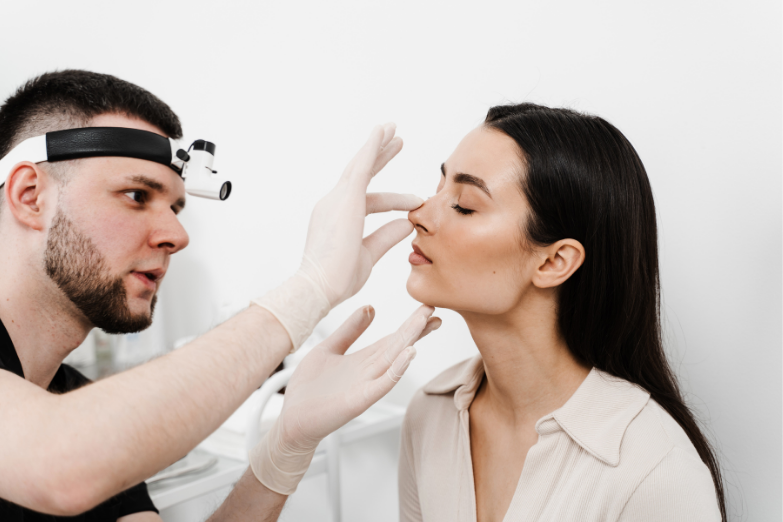
A silicone implant can raise a low nose bridge with a relatively straightforward operation and no cartilage-harvesting scar. However, it carries long-term risks such as infection, shifting, visible edges and extrusion. Rib cartilage requires an additional procedure and leaves a small chest scar, but it uses the patient’s own tissue. The better option depends on skin thickness, nasal anatomy, previous surgery, infection history and the amount of augmentation required.
How do silicone implants and rib cartilage raise the bridge differently?
Both materials can increase the height and definition of the nasal bridge, also called the dorsum. However, they behave differently because silicone is an artificial implant, while rib cartilage is tissue taken from the patient’s own body.
Silicone nasal implant: A surgeon places a shaped, medical-grade silicone implant beneath the nasal skin and soft tissue to increase bridge height. It does not require harvesting cartilage from another part of the body. The implant’s shape, size, position and coverage by the surrounding tissue are important to the result.
Rib cartilage graft: Cartilage is taken from a rib through an incision on the chest, then shaped and placed in the nose. It can be used to build the bridge, support nasal structures or reconstruct areas affected by previous surgery. The amount and shape of cartilage available influence the surgical plan.
Neither option is automatically best for every low bridge. A modest augmentation with healthy, adequately thick skin presents different challenges from a major reconstruction in a nose with thin skin or previous implant complications.
Silicone implant vs rib cartilage: Comparison table
| Factor | Silicone implant | Rib cartilage |
|---|---|---|
| Material | Medical-grade synthetic implant | Patient’s own cartilage |
| Surgery time | Often shorter because there is no cartilage harvest | Usually longer because harvesting and shaping take additional time |
| Donor scar | No cartilage-harvesting scar | Small chest scar |
| Infection | Implant infection can require removal | Infection is possible, although there is no permanent synthetic implant |
| Shifting | Can move or become displaced | Can shift if graft fixation or support is inadequate |
| Extrusion | Can erode through the skin or lining in serious cases | Does not undergo silicone implant extrusion, but graft-related complications remain possible |
| Warping | Not applicable in the same way as cartilage | Cartilage may bend or warp during healing |
| Visible edges | More noticeable with thin skin or an unsuitable implant | Graft edges may also become visible if poorly shaped or inadequately covered |
| Tip safety | Requires particular caution near the tip, where pressure can damage tissue | Can provide structural support when appropriately designed |
| Revision surgery | May need removal, replacement or reconstruction | May be useful for reconstruction, although available cartilage and prior surgery matter |
| Ten-year outlook | Can remain in place for years, but complications may develop later | Can provide long-term support, although resorption, warping and other changes are possible |
This comparison describes general differences rather than guaranteed outcomes. Surgical technique, tissue quality, implant design, infection prevention and the patient’s healing response all influence the result.
What are the long-term risks of a silicone nose implant?
A silicone implant may provide the intended bridge shape for many years. However, it should not be considered risk-free simply because the early recovery is uncomplicated.
Important complications include:
Infection: Bacteria can infect the tissues around an implant. Symptoms may include increasing redness, pain, swelling, warmth or discharge. Some infections require antibiotics, while others may need implant removal and further treatment.
Shifting or displacement: The implant may move from its intended position, creating an uneven bridge or an asymmetrical appearance. Implant shape, pocket preparation, fixation and healing can influence this risk.
Visible edges or an unnatural outline: If the skin and soft tissue are thin, implant borders may become visible. An implant that is too large or poorly matched to the nasal anatomy may look artificial.
Extrusion: In serious cases, pressure and tissue damage can cause the implant to erode through the skin or nasal lining. This is a significant complication that requires prompt medical attention.
Capsule formation and contracture: The body forms scar tissue around an implant. In some cases, the surrounding tissue can tighten or distort the shape.
Skin thinning or colour change: Persistent pressure, inflammation or inadequate tissue coverage can damage the overlying skin.
These complications do not occur in every patient. Nevertheless, they are important to discuss before choosing a synthetic implant, particularly if the planned augmentation is large or the skin is thin.
Who is a good candidate for a silicone implant, and who is not?
A silicone implant may be considered when the primary goal is dorsal augmentation and the surgeon determines that the patient’s anatomy offers sufficient soft-tissue coverage.
Potential considerations include:
- Adequate skin and soft-tissue thickness over the bridge
- No active nasal or skin infection
- A realistic goal for bridge height and shape
- Suitable nasal anatomy for implant placement
- Understanding that future removal or revision may be necessary
- Willingness to attend follow-up appointments
Silicone may be less suitable when the skin is very thin, the desired augmentation places excessive pressure on the tissue, or the nose has a history of implant infection, exposure or repeated revision surgery.
A patient with a previous implant complication may need reconstruction rather than simply replacing one implant with another. The surgeon must assess the condition of the skin, scar tissue, nasal lining and supporting structures.
The material should not be selected from photographs alone. A physical examination is necessary to determine whether the proposed implant can be covered safely and whether the planned shape is realistic.
Why might rib cartilage be preferred for thin skin or revision surgery?
Rib cartilage provides the surgeon with the patient’s own tissue and can be shaped to suit the reconstruction. It is particularly useful when additional structural support is needed or when an existing implant has caused complications.
It may be considered for:
- Thin nasal skin requiring careful structural planning
- Revision rhinoplasty after previous surgery
- Reconstruction following implant infection or exposure
- Significant bridge augmentation
- Nasal support problems that require grafting
- Cases where a synthetic implant is considered unsuitable
Rib cartilage does not eliminate complications. It can warp, become irregular, resorb to some degree or require further correction. Its use also introduces a second surgical site, with possible chest pain, scarring, bleeding and, rarely, more serious complications such as pneumothorax.
The choice should balance the amount of augmentation needed, the quality of the nasal tissues, the patient’s preferences and the surgeon’s assessment of the risks.
What does rib cartilage harvesting involve?
Rib cartilage harvesting involves taking a suitable portion of cartilage from the chest through an incision. The surgeon then shapes the cartilage into one or more grafts for use in the nose.
The procedure adds operative time and creates a second area that must heal. Patients may experience chest soreness, discomfort with certain movements and a scar. The duration of recovery varies with the amount of cartilage harvested, the surgical technique and individual healing.
The surgeon should explain:
- Where the chest incision will be placed
- The expected scar and how it may heal
- How chest discomfort will be managed
- When normal activities can be resumed
- How the graft will be shaped and secured
- The possibility of warping or further surgery
Rib cartilage is not automatically necessary for every low bridge. Smaller augmentation requirements may be managed with other grafting options when clinically appropriate. The decision depends on the anatomy and the reconstructive goal.
Is rib cartilage prone to warping?
Yes. Rib cartilage can change shape after harvesting and carving, a complication commonly called warping. This may affect the straightness or symmetry of the nasal bridge.
Surgeons use graft-selection and shaping techniques to reduce this risk, but no technique can guarantee that warping will never occur. The final result also depends on graft placement, fixation, surrounding tissue forces and healing.
Other possible graft-related problems include infection, irregular contours, resorption and the need for revision. These risks should be discussed alongside the advantages of using the patient’s own tissue.
Can diced cartilage be used instead of a solid graft?
In selected cases, surgeons may use diced cartilage rather than a single solid piece. Small cartilage fragments can be placed within a suitable carrier or prepared for a particular reconstructive purpose.
Diced cartilage may help address certain contour irregularities or augmentation needs, but it is not interchangeable with every solid structural graft. Its suitability depends on the required height, the need for support, the location of the defect and the surgeon’s technique.
For example, a graft intended to provide firm structural support may require a different design from material used to smooth a small contour irregularity. The surgeon should explain why a particular graft format is appropriate for the planned procedure.
What happens if a silicone implant has to come out?
Removal may be necessary if an implant becomes infected, shifts significantly, threatens the skin, becomes exposed or causes an unacceptable contour problem. Some patients also request removal because they no longer want the implant.
The next step depends on the condition of the nose.
- Removal alone: May be considered when the nasal structure remains adequate and the patient does not want immediate replacement.
- Removal with replacement: May be considered in selected cases, but replacing an implant is not always the safest solution.
- Removal with cartilage reconstruction: May be appropriate when tissue support is inadequate or the implant has damaged the surrounding structures.
- Staged reconstruction: May be necessary when infection, inflammation or tissue damage must settle before definitive reconstruction.
Removing an implant does not automatically restore the nose to its original shape. Scar tissue, stretched skin, thinning tissue or weakened support may affect the result. If infection is present, the surgeon may recommend treating it before planning further augmentation.
Where can you seek a silicone implant removal nose Mumbai assessment?
If you are researching silicone implant removal nose mumbai, ask the treating surgeon to assess the implant’s position, skin coverage, signs of infection and the strength of the underlying nasal structures. Bring details of the original surgery, implant type if known, previous complications and any earlier operative records. The assessment should clarify whether removal alone, replacement or cartilage-based reconstruction is appropriate.
How long does a silicone nose implant last?
There is no universal expiry date for a silicone nasal implant. Some implants remain in place for many years without major problems, while others develop complications earlier. A good result at one year cannot guarantee that the implant will remain complication-free for the next ten years.
Long-term monitoring should consider:
- Changes in bridge shape or symmetry
- New tenderness or persistent discomfort
- Redness, swelling or discharge
- Increasing visibility of implant edges
- Skin thinning or colour changes
- Any sign that the implant is approaching the skin surface
Do not wait for a scheduled review if new symptoms develop. Prompt examination may help identify a complication before more extensive tissue damage occurs.
What does the ten-year picture look like?
A ten-year comparison is best understood as a discussion of possible long-term outcomes, not a prediction for an individual patient.
Silicone: The implant may continue to provide bridge height, but infection, displacement, capsule-related changes, skin thinning and extrusion remain possible. A patient may eventually need removal or revision even after years without obvious problems.
Rib cartilage: The graft may integrate with surrounding tissue and provide lasting structural support. However, warping, resorption, contour irregularity and changes associated with ageing or previous surgery may affect the result.
For both materials: The nose continues to age. Skin, soft tissue, cartilage and other supporting structures can change over time. The result depends not only on the graft material but also on surgical planning, tissue quality, healing and the original nasal anatomy.
The practical question is not simply which material lasts longer. It is which material can achieve the intended shape while keeping the long-term risk acceptable for that particular nose.
Does a nose implant affect breathing?
A bridge implant is primarily intended to change the external contour, but nasal surgery can affect breathing if the procedure alters internal structures, creates swelling or contributes to narrowing or scarring.
Breathing difficulty is not an inevitable result of an implant. However, anyone with pre-existing obstruction, a deviated septum, nasal valve problems or previous nasal surgery should have these issues assessed before cosmetic augmentation.
Tell the surgeon about persistent blockage, mouth breathing, snoring or difficulty breathing through either nostril. The surgical plan should account for nasal function as well as appearance.
How should you prepare for a material-selection consultation?
A useful consultation should cover more than implant height or the shape shown in a photograph.
Ask the surgeon:
- Is my skin thick enough to cover a silicone implant safely?
- Would rib cartilage offer a meaningful advantage in my case?
- What are the risks of infection, displacement, visible edges and extrusion?
- If cartilage is recommended, where will it be harvested and what scar should I expect?
- How will the procedure affect my breathing?
- What could happen if the implant or graft needs revision years later?
- Which alternatives are suitable for the amount of augmentation I want?
- What follow-up will be required, and which symptoms need urgent review?
Share your medical history, previous nasal operations, medication use and any history of infection or poor wound healing. The surgeon should explain the alternatives, limitations, expected recovery and possible need for further surgery before you consent.
Frequently asked questions
A silicone implant may be suitable for selected patients who want bridge augmentation, provided the skin and soft tissues can cover it adequately and the nasal anatomy is appropriate. Risks include infection, shifting, visible edges and extrusion. A qualified surgeon should assess the nose and discuss cartilage alternatives before recommending a material.
Neither material is best for everyone. Silicone avoids a cartilage-harvesting incision and may involve a shorter operation, but it carries implant-specific risks. Rib cartilage requires an additional harvest procedure and can warp, but may be useful for thin skin, reconstruction or revision cases. The decision depends on anatomy, tissue quality and surgical goals.
Possible complications include infection, shifting, an unnatural outline, visible edges, scar-tissue changes, skin thinning and extrusion. Not every patient develops these problems, but they can require treatment or revision surgery. Increasing redness, pain, swelling, discharge or skin breakdown around an implant needs prompt medical assessment.
A silicone nasal implant may remain in place for many years, but there is no guaranteed lifespan or complication-free ten-year outcome. Changes can develop long after surgery. Follow-up is important, and new pain, swelling, redness, displacement or skin thinning should be assessed rather than ignored.
Yes, in selected cases, an implant can be removed and cartilage used for reconstruction. The timing and approach depend on whether infection is present, how much the surrounding tissue has been affected and how much structural support remains. Some patients need staged treatment rather than immediate replacement.
Yes. Rib cartilage can bend or change shape after it is carved and placed. Surgeons use techniques intended to reduce warping, but the risk cannot be eliminated completely. Other possible problems include irregular contours, resorption, infection and donor-site discomfort. The expected benefits and limitations should be discussed before surgery.
Diced cartilage may be useful for selected augmentation or contour-correction goals, but it is not suitable for every situation. A solid graft may be needed when stronger structural support is required. The choice depends on the location of the defect, the amount of augmentation and the surgeon’s reconstructive plan.
A dorsal implant does not necessarily cause breathing problems, but nasal surgery can affect function through swelling, scarring or changes to supporting structures. People with existing blockage or previous nasal surgery should have their breathing assessed before treatment. The plan should consider nasal function alongside cosmetic goals.
Before a silicone implant removal nose Mumbai consultation, gather your original surgery details, implant information if available, and records of any infection or revision. Ask whether removal alone is sufficient or whether cartilage reconstruction may be needed. If the implant is exposed or there are signs of infection, seek prompt medical assessment rather than delaying care.