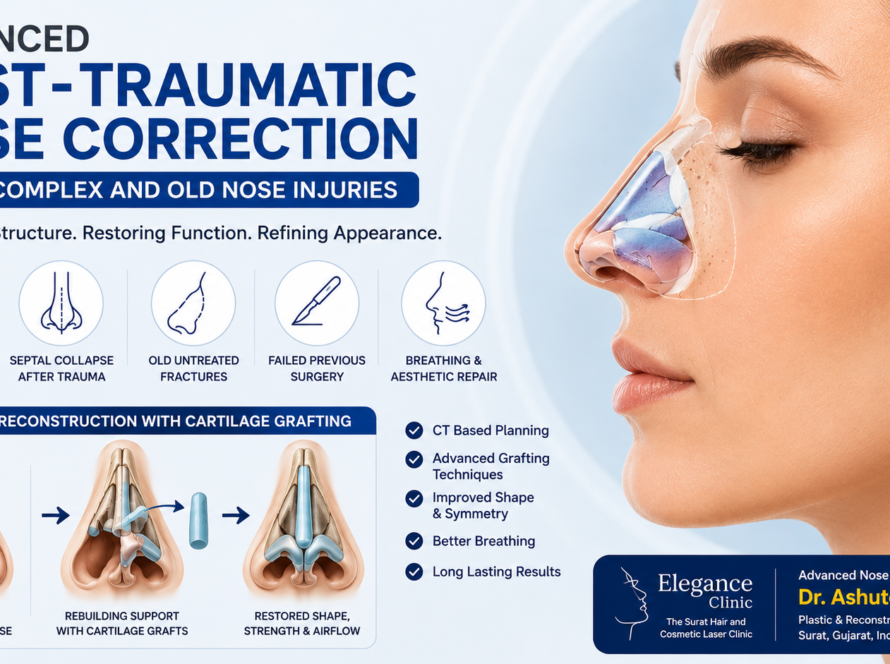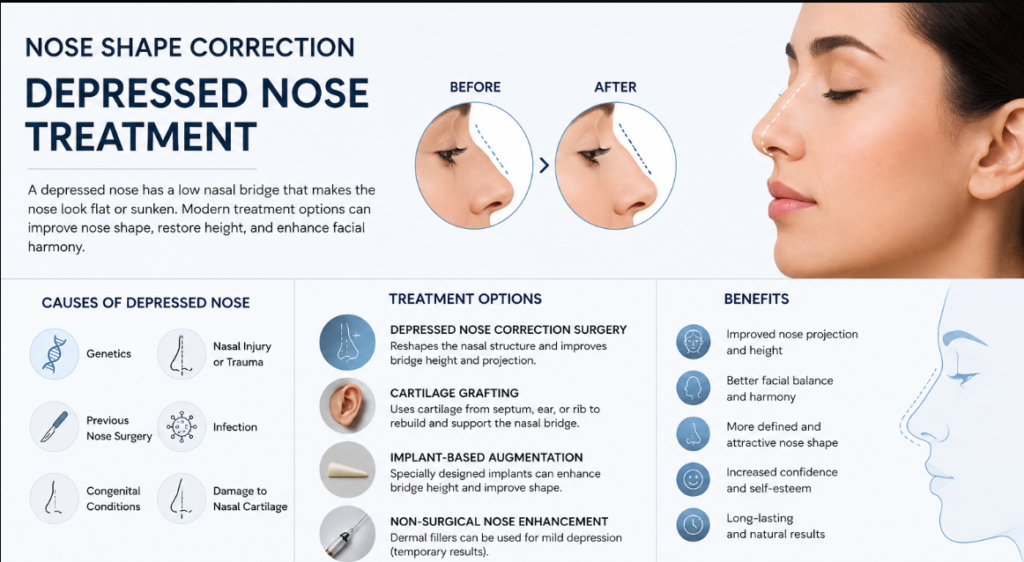
When the bridge of the nose appears sunken, flattened, or lacks adequate projection, it is commonly referred to as a Depressed Nose. This condition can affect facial harmony and, in some cases, may also contribute to functional concerns.
Fortunately, modern cosmetic and reconstructive procedures can improve the appearance of a depressed nose and restore a more balanced facial profile.
At Elegance Clinic, Surat, Dr. Ashutosh Shah offers personalized treatment options for patients seeking nose shape correction and depressed nose enhancement.
What Is a Depressed Nose?
A depressed nose is a condition in which the nasal bridge appears lower than normal.
The severity of the condition varies from person to person. Some individuals are born with a naturally low nasal bridge, while others develop the condition due to injury, previous surgery, infection, or structural changes.
What Are the Signs of a Depressed Nose?
Common features include:
- Flat nasal bridge
- Sunken appearance of the nose
- Reduced nose projection
- Poor facial balance
- Broad or flattened nasal profile
- Less defined side profile
- Dissatisfaction with nose appearance
Some patients may also experience breathing concerns depending on the underlying cause.
Causes of a Depressed Nose
Genetic Factors
Many individuals naturally have a low nasal bridge due to inherited facial characteristics.
Previous Nasal Injury
Trauma or fractures can damage the nasal framework and lead to collapse or flattening of the bridge.
Previous Nose Surgery
Inadequate structural support after surgery can occasionally result in a depressed nasal appearance.
Infection
Certain infections may damage the nasal cartilage and affect the shape of the nose.
Congenital Conditions
Some individuals are born with structural nasal differences that contribute to a depressed appearance.
What Is Nose Shape Correction?
Nose shape correction refers to treatments designed to improve the appearance, projection, and balance of the nose.
The treatment approach depends on:
- Degree of depression
- Nasal anatomy
- Skin thickness
- Facial proportions
- Patient expectations
- Functional concerns
Depressed Nose Treatment Options
1. Depressed Nose Correction Surgery
For significant structural depression, surgical correction is often the most effective solution.
The procedure may involve:
- Reshaping the nasal framework
- Improving bridge height
- Enhancing projection
- Restoring facial balance
- Supporting nasal structure
The treatment is customized according to the patient’s anatomy and aesthetic goals.
2. Cartilage Grafting
Cartilage grafts may be used to rebuild and support the nasal bridge.
it can be obtained from:
- Nasal septum
- Ear cartilage
- Rib cartilage (in selected cases)
The graft helps create a stronger and more defined nasal contour.
3. Implant-Based Nose Augmentation
In some cases, specially selected implants may be used to improve bridge projection and shape.
The suitability of implants depends on individual anatomy and treatment objectives.
4. Non-Surgical Nose Enhancement
Selected patients with mild depression may be candidates for temporary non-surgical correction using injectable fillers.
However, surgical correction generally provides more comprehensive and long-lasting improvement for significant structural concerns.
How Is Depressed Nose Correction Surgery Performed?
Consultation
The treatment begins with a detailed assessment of facial proportions, nasal structure, and patient goals.
Surgical Planning
A customized plan is created to achieve natural-looking improvement while maintaining facial harmony.
Procedure
The surgery is performed under appropriate anesthesia.
Depending on the case, cartilage grafts, structural reconstruction, or augmentation techniques may be used to elevate and reshape the nasal bridge.
Recovery
Patients receive detailed post-operative instructions to support healing and achieve optimal results.
Benefits of Depressed Nose Correction
Patients may experience:
- Improved nasal projection
- Better facial balance
- Enhanced side profile
- More defined nose shape
- Increased confidence
- Natural-looking appearance
- Long-lasting improvement
Recovery After Nose Shape Correction
Recovery varies according to the complexity of the procedure.
Temporary effects may include:
- Mild swelling
- Bruising
- Nasal congestion
- Temporary discomfort
Most swelling gradually improves over time as the nose heals.
Results of Depressed Nose Treatment
As healing progresses, patients typically notice:
- Improved bridge height
- Better projection
- Enhanced facial harmony
- More balanced profile
Final results continue to refine as swelling subsides.
Who Is a Good Candidate?
You may be a suitable candidate if:
- You have a flat or depressed nasal bridge
- You are unhappy with your nose profile
- You have realistic expectations
- You are in good overall health
- You desire long-term improvement
Why Choose Dr. Ashutosh Shah?
Dr. Ashutosh Shah provides individualized evaluation and treatment planning for patients seeking cosmetic and reconstructive nose procedures.
At Elegance Clinic, Surat, treatment focuses on:
- Natural-looking outcomes
- Facial harmony
- Structural support
- Patient safety
- Personalized care
Every procedure is tailored to the patient’s unique facial anatomy and aesthetic goals.
Book a Consultation at Elegance Clinic
If you are looking for Nose Shape Correction or treatment for a Depressed Nose, a professional consultation can help determine the most suitable solution.
Dr. Ashutosh Shah at Elegance Clinic, Surat offers advanced treatment options for depressed nose correction with a focus on facial balance, structural support, and natural-looking results.
Frequently Asked Questions
A depressed nose refers to a nose with a low, flattened, or sunken bridge that lacks normal projection.
Yes. Both surgical and selected non-surgical treatments are available depending on the severity of the condition.
The goal of treatment is to create a nose that complements the patient’s facial features while maintaining a natural appearance.
In some cases, structural abnormalities associated with a depressed nose may contribute to breathing concerns.